

Zone Skipping: Cut Parcel Shipping Costs Up to 30%
Every time a parcel crosses an additional carrier zone on its way to a customer, your shipping bill climbs. For high-volume shippers, those zone charges compound across thousands of shipments every week, and carriers count on it. Zone skipping is a proven linehaul strategy that puts high-volume shippers back in control. By consolidating parcels into freight and injecting them closer to the final delivery zone, businesses can cut per-package transportation costs by up to 30% while simultaneously speeding up regional delivery. This guide explains exactly how zone skipping works, when it makes sense, and how to evaluate whether it belongs in your shipping strategy.
Get a free shipping analysis from Shipware and see how much zone skipping could save your business.
Understanding Parcel Shipping Zones
Major carriers like UPS and FedEx divide the United States into shipping zones numbered roughly 1 through 8 based on the distance between the origin ZIP code and the destination ZIP code. Zone 1 represents the shortest distance (often same-state delivery), while Zone 8 covers the greatest cross-country distances.
Zone classification directly determines the base transportation rate for every package you ship. Each additional zone a parcel must travel typically raises shipping costs by 8 to 15 percent. A package traveling Zone 2 might cost $8.50 to ship; the identical package traveling Zone 7 from the same origin could cost $16.00 or more, nearly double, before a single accessorial fee is added.
For shippers moving thousands of parcels per week from a single distribution center, this zone-based pricing structure creates a systematic cost disadvantage. Customers concentrated on the opposite coast from your warehouse effectively pay a premium, or you absorb the difference to stay competitive on shipping offers. Zone skipping addresses this structural problem head-on. For more on how carrier rate structures work, see our shipping glossary.
What is Zone Skipping?
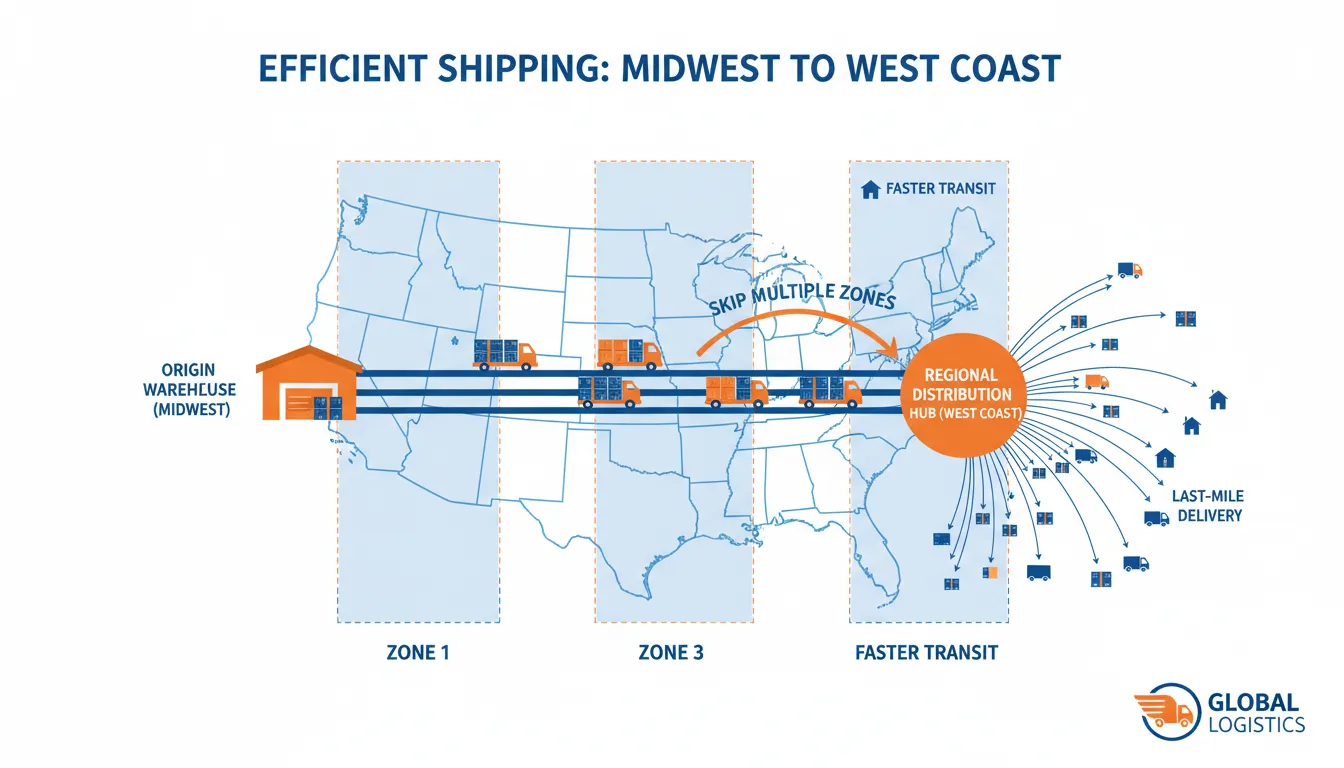
Zone skipping is a logistics strategy in which a high-volume shipper consolidates individual parcels destined for the same region, moves them together as a bulk freight shipment (via full truckload or less-than-truckload) to a facility near the final delivery zone, and then injects the parcels into last-mile delivery locally. Because the packages are inducted into the carrier network near their final destinations, they are rated and billed as short-zone shipments at Zone 2 or Zone 3 rates rather than the long-distance Zone 7 or Zone 8 rates they would otherwise incur.
The term “zone skipping” refers precisely to this effect: the parcel literally skips the intermediate zones it would have crossed during a conventional door-to-door carrier shipment. Instead of individual packages traveling across the country through multiple carrier sortation facilities, they ride together as consolidated freight to a regional hub, then disperse for local delivery. This approach works alongside carrier contract optimization to create compounding cost advantages for high-volume shippers.
How Zone Skipping Works: Step by Step
A zone skipping program typically follows this process:
- Consolidation at origin. At your distribution center or fulfillment facility, outbound parcels destined for the same geographic region are sorted and palletized together rather than injected individually into the carrier network.
- Linehaul movement as freight. The consolidated pallet load moves via full truckload (FTL) or less-than-truckload (LTL) freight to a regional hub or carrier facility located close to the destination zone. This linehaul leg travels by the most cost-efficient freight mode available, with per-package costs far below what carriers charge for individual parcel transit across the same distance.
- Deconsolidation at the regional hub. At the destination facility, pallets are broken down and individual parcels are inducted into the local carrier network, whether a national carrier like UPS or FedEx, a regional carrier, or USPS for last-mile delivery.
- Last-mile delivery at short-zone rates. Each parcel now moves a short distance to the final customer. Because the carrier only sees a local injection point, it bills the short-zone rate for that final delivery leg rather than a cross-country rate from your origin facility.
The result is a two-part shipping cost: freight (linehaul) plus regional last-mile, a combination that is typically substantially cheaper than paying per-parcel Zone 7 or Zone 8 rates for the same volume of shipments. To see how LTL versus parcel decisions factor into this, read our analysis on LTL vs. UPS/FedEx hundredweight programs.
How Zone Skipping Reduces Parcel Shipping Costs
Lower Per-Package Rates Through Freight Consolidation
The core economic advantage of zone skipping comes from the fundamental cost difference between parcel shipping and freight. When you ship an individual package across the country, you pay a carrier to handle, sort, scan, and move that single box through multiple facilities. Each touchpoint adds cost. When you move the same package as part of a 500-piece pallet load, the per-unit handling cost drops dramatically.
FTL and LTL rates are calculated on the full load, not per package. Spreading that linehaul cost across hundreds or thousands of parcels produces a per-package freight cost that is far lower than what you would pay to move each parcel individually across the same distance. The zone skipping calculation then becomes: linehaul cost per package plus last-mile cost per package versus your current long-haul per-package rate. When volumes are sufficient, the consolidated approach consistently wins.
Bypassing Costly Long-Distance Zone Charges
Every additional zone a parcel travels adds a rate increment that grows non-linearly. The jump from Zone 4 to Zone 5 costs less than the jump from Zone 6 to Zone 7. The most expensive transnational zone rates, Zones 7 and 8, are where zone skipping delivers its most dramatic savings.
By injecting parcels into the carrier network in the destination region, you effectively eliminate Zone 5, 6, 7, and 8 charges entirely. Each parcel is billed from its regional injection point, not from your origin facility. For shippers whose volume is naturally concentrated in a geographic region far from their distribution center, such as a Midwest-based manufacturer shipping heavily to the West Coast, zone skipping can reduce per-package carrier costs by a meaningful percentage of total shipping spend. Zone skipping can reduce parcel transportation costs by up to 30% compared to conventional origin-injected parcel shipping. Read more about proven strategies for reducing parcel costs.
Additional Benefits of Zone Skipping
Faster Regional Delivery
Conventional long-haul parcel shipping routes packages through multiple carrier sortation facilities. A package traveling from Illinois to California may pass through four to six carrier hubs over three to five business days. Zone skipping can compress that timeline by eliminating the intermediate sortation steps. Once the linehaul freight arrives in the destination region, often overnight or within one to two days, last-mile delivery completes quickly because each package is already near its final destination. For shippers whose customers expect fast, consistent delivery, zone skipping can simultaneously lower cost and improve service level.
Fewer Touchpoints, Less Damage and Loss
Every facility a package passes through represents a handling event, a touchpoint where damage or loss can occur. Zone skipping reduces the number of carrier touchpoints each parcel encounters. Packages travel the long distance as consolidated freight on a pallet, which tends to be handled less roughly than individual parcels moving through high-speed sortation equipment at multiple facilities. Shippers who implement zone skipping programs frequently see measurable reductions in damage claims and lost-package incidents, which represents another category of cost savings beyond the direct shipping rate reduction. Our invoice audit and recovery service can capture additional savings by identifying billing errors on both linehaul and last-mile legs.
Regional Carrier Advantages
Once freight arrives near the destination, zone skipping opens the door to regional carrier options that may not be available when shipping from your origin facility. Regional carriers like OnTrac, LSO, Eastern Connection, and others often offer competitive last-mile rates within their service areas and frequently deliver faster than national carriers for in-region shipments. These carriers can be integrated into a zone skipping program to capture additional savings and service improvements at the last-mile stage that a conventional national carrier contract cannot provide. See our breakdown of how regional carriers fit into the supply chain for more detail.
Is Zone Skipping Right for Your Business?
Zone skipping is not the right strategy for every shipper. Several conditions need to be in place for a zone skipping program to generate positive ROI.
Volume Requirements
Zone skipping requires enough consistent outbound volume to a specific region to justify the logistics of consolidation and freight movement. A shipper moving fewer than a few hundred parcels per week to a given region may struggle to fill trucks efficiently or keep linehaul costs competitive on a per-package basis. High-volume shippers, typically those spending $1 million or more annually on parcel shipping, are the most natural candidates. Shippers who cannot fill their own loads can often partner with a 3PL that consolidates freight from multiple shippers to achieve similar economies. Learn how 3PL contract optimization complements zone skipping programs.
Distribution Center Capabilities
Successful zone skipping programs require the ability to sort outbound parcels by destination region at the origin facility before they enter the carrier network. This sounds straightforward but requires physical space, operational processes, and often warehouse management system (WMS) support to execute consistently without delays. If outbound parcels are already sorted and injected into the carrier network in a single commingled stream, implementing zone skipping may require an operational process change at your distribution center.
Consistent Geographic Shipping Patterns
Zone skipping works best when your shipping volume is consistently concentrated in identifiable regions. If your outbound shipments are spread evenly across the country with no regional concentration, it is difficult to accumulate enough volume to a single region to make linehaul economics work. Shippers with seasonal or highly variable volume patterns also face challenges; irregular volume can make it difficult to maintain efficient load factors on the linehaul leg.
Delivery Time Commitments
Zone skipping introduces a linehaul transit step between origin and the regional injection point, which typically adds one to two days to the movement. If your customers expect guaranteed next-day or two-day delivery nationally, zone skipping may not align with your service level commitments unless you have regional distribution centers positioned to minimize linehaul distances. Shippers who offer standard five- to seven-day ground delivery as their default service have more flexibility to implement zone skipping without affecting customer expectations.
How to Evaluate the ROI of Zone Skipping
The financial case for zone skipping rests on a straightforward comparison:
- Current cost: Your average per-package rate for long-distance Zone 5 through Zone 8 shipments to the target region
- Zone skipping cost: Linehaul cost per package (total freight cost divided by total parcels in the load) plus last-mile cost per package at the regional injection rate
If zone skipping cost is lower than current cost, and it is for most high-volume shippers with the right geographic concentration, you have a positive ROI case. Additional factors to fold into the analysis include reduced damage and claims, potential transit time improvements (which can affect customer satisfaction metrics and return rates), and any incremental labor or systems investment required to execute the program.
An accurate analysis requires real shipping data at the lane level: actual origin-to-destination zone distributions, current carrier rates, and realistic freight quotes for the consolidation lanes you are considering. Working from averages or published rates will produce unreliable projections. Shipware’s spend management portal gives clients full visibility into zone distributions and lane-level economics to make this analysis fast and accurate.
Zone Skipping as Part of a Broader Shipping Optimization Strategy
Zone skipping is a powerful cost-reduction lever, but it works best as one component of a comprehensive shipping optimization strategy rather than a standalone tactic. Shippers who pursue zone skipping alongside carrier contract optimization, negotiating improved rates, accessorial caps, and favorable terms with UPS, FedEx, and regional carriers, create compounding cost advantages. A well-negotiated carrier contract reduces the baseline rates on every shipment, including last-mile rates in a zone skipping program, multiplying the savings from both strategies.
Similarly, modal optimization, ensuring that each shipment moves via the most cost-effective service level whether parcel, LTL, or truckload, complements zone skipping by ensuring the linehaul leg itself is priced correctly. And ongoing invoice audit and recovery ensures that billing errors on both the linehaul and last-mile legs are caught and refunded, protecting the economics of the entire program. Explore all of Shipware’s shipping optimization solutions to see how these strategies work together.
How Shipware Helps High-Volume Shippers Reduce Costs with Zone Skipping and Beyond
Shipware’s team includes former UPS and FedEx pricing executives with over 100 years of combined carrier experience, professionals who built and negotiated carrier rate structures from the inside. That insider knowledge translates directly into better outcomes for clients pursuing zone skipping, contract renegotiation, or any other shipping cost reduction strategy.
Shipware’s approach begins with a comprehensive analysis of your actual shipping data: zones, weights, services, accessorial profiles, and current contract terms. From that foundation, we model zone skipping scenarios alongside contract optimization opportunities to identify the highest-impact actions for your specific shipping profile. Clients across all industries achieve an average of 21.5% savings on annual shipping costs, without switching carriers or changing service levels.
If your business is spending $500K or more annually on parcel shipping, there is a strong probability that zone skipping, combined with a renegotiated carrier contract, can meaningfully reduce that number. The analysis is free, and the fee model is performance-based: if we do not save you money, you do not pay.
Request a free shipping analysis from Shipware today and find out exactly how much zone skipping and carrier contract optimization could save your business.
Frequently Asked Questions About Zone Skipping
What types of shippers benefit most from zone skipping?
Zone skipping delivers the greatest ROI for high-volume shippers moving significant parcel volumes to regions far from their distribution centers, typically Zone 5 through Zone 8 destinations. Businesses spending $1 million or more annually on parcel shipping and with identifiable geographic concentrations in their outbound volume are the strongest candidates.
Does zone skipping require changing my carrier?
No. Zone skipping can be implemented while maintaining relationships with your existing national carriers for last-mile delivery. Many zone skipping programs use the same carriers (UPS, FedEx, USPS) for the final delivery leg, simply injecting freight at a regional facility rather than the origin point.
Can I use zone skipping if I only ship with one carrier?
Yes, though working with multiple carriers or regional carriers for the last-mile leg can improve the economics. Some shippers use their primary national carrier for both the linehaul consolidation and last-mile delivery by working directly with that carrier’s freight injection programs.
What is the minimum volume needed for zone skipping?
There is no universal minimum, but zone skipping typically requires enough consistent volume to a target region to fill or share FTL or LTL loads efficiently without creating delivery delays. Shippers who cannot independently fill loads can work with a 3PL to co-load freight with other shippers and access similar economics.
How does zone skipping affect shipment tracking visibility?
During the linehaul freight leg, individual parcel tracking is less granular than in conventional parcel shipping, since packages are moving as consolidated freight rather than individual tracked units. Once parcels are inducted at the regional facility for last-mile delivery, standard parcel tracking resumes. Some shippers address customer visibility concerns by using estimated delivery windows during the freight transit phase.