
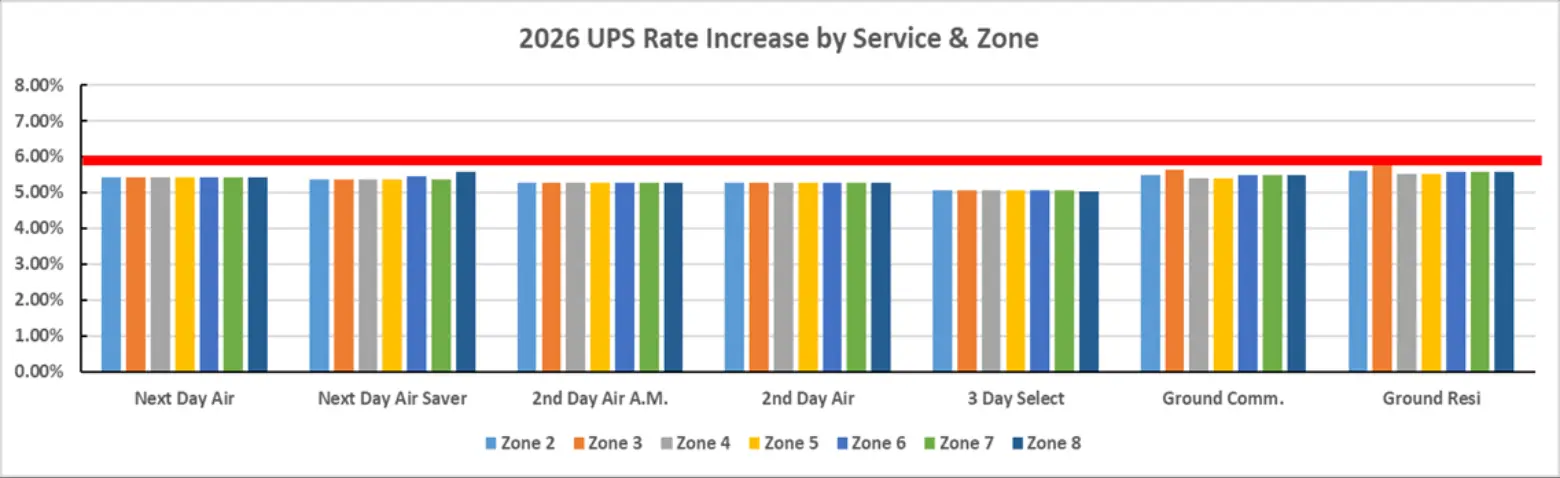
UPS has announced a 5.9% General Rate Increase (GRI) effective December 22, 2025, matching FedEx’s upcoming increase on January 5, 2026.
While the figure matches last year’s hike, it’s only an average. The real impact varies widely by service type, package weight, and distance. For many shippers, especially those handling lightweight parcels, actual costs will climb well above 5.9%.
The 5.9% UPS GRI Hits Light, Fast Shipments Hardest
UPS’s 2026 rate increase will not be evenly distributed. Shipments in the 1–5 lb. Range, especially in Next Day Air, 2nd Day Air, and Ground Residential, will experience increases well above the stated average.
Heavier shipments (6–10 lbs. and beyond) will see smaller increases, some even below 5.9%. That means e-commerce and direct-to-consumer businesses that rely on small, fast deliveries will feel the biggest impact.
FedEx Sets the Pace as UPS Follows with Matching 2026 GRI
For the second year in a row, FedEx announced its rate increase first, with UPS following weeks later. The timing matters. FedEx’s early move allows it to set market expectations, leaving UPS to react strategically and maintain parity.
This dynamic underscores the strength of the carrier duopoly. Few other industries allow vendors to announce annual price hikes with near certainty that customers will comply, yet both UPS and FedEx have done exactly that.
Table 1:
| Surcharge | 2025 Rate | June 2025 Rate | 2026 Rate | Percentage Increase |
|---|---|---|---|---|
| Additional Handling, Weight | ||||
| Zone 2 | $43.50 | $43.50 | $46.50 | 6.90% |
| Zones 3-4 | $47.50 | $47.50 | $50.75 | 6.84% |
| Zones 5-6 | $52.75 | $52.75 | $56.25 | 6.64% |
| Zones 7+ | $52.75 | $55.00 | $58.75 | 11.37% |
| Additional Handling, Length/Width | ||||
| Zone 2 | $28.00 | $28.00 | $30.00 | 7.14% |
| Zones 3-4 | $31.00 | $31.00 | $33.25 | 7.26% |
| Zones 5-6 | $36.00 | $36.00 | $38.50 | 6.94% |
| Zones 7+ | $36.00 | $38.00 | $40.50 | 12.50% |
| Additional Handling, Packaging | ||||
| Zone 2 | $25.00 | $25.00 | $26.75 | 7.00% |
| Zones 3-4 | $29.00 | $29.00 | $31.00 | 6.90% |
| Zones 5-6 | $31.00 | $31.00 | $33.25 | 7.26% |
| Zones 7+ | $31.00 | $31.50 | $33.75 | 8.87% |
| Large Package Surcharge, Commercial | ||||
| Zone 2 | $205.00 | $205.00 | $219.50 | 7.07% |
| Zones 3-4 | $225.00 | $225.00 | $239.50 | 6.44% |
| Zones 5-6 | $250.00 | $250.00 | $273.00 | 9.20% |
| Zones 7+ | $250.00 | $260.00 | $286.00 | 14.40% |
| Large Package Surcharge, Residential | ||||
| Zone 2 | $240.00 | $240.00 | $254.50 | 6.04% |
| Zones 3-4 | $260.00 | $260.00 | $274.50 | 5.58% |
| Zones 5-6 | $297.50 | $297.50 | $320.50 | 7.73% |
| Zones 7+ | $297.50 | $305.00 | $331.00 | 11.26% |
| Over Maximum Limits | $1,325.00 | $1,775.00 | $1,875.00 | 41.51% |
UPS Moderates Surcharge Hikes but Adds New Zone 7 Pricing Pressure
After last year’s steep surcharge increases—some exceeding 26%—UPS is showing restraint. For 2026, Additional Handling and Large Package fees will rise in the 7–9% range across most zones.
But there’s a key structural change: UPS is introducing a new, higher fee tier for Zone 7. The shift suggests UPS is flexing pricing power on long-distance shipments, where regional carriers offer less competition.
Lightweight Packages Drive the Sharpest Rate Increases Across Services
The data shows a consistent pattern: lighter parcels face the steepest increases. Every major UPS service except 3 Day Select shows its largest percentage hikes in the 1–5 lb. weight category.
This approach differs from 2025, when UPS raised prices more aggressively across mid-weight tiers such as 2nd Day Air. The new strategy appears to target high-volume, low-weight e-commerce shippers who have few alternatives for fast delivery.
Chart 1:
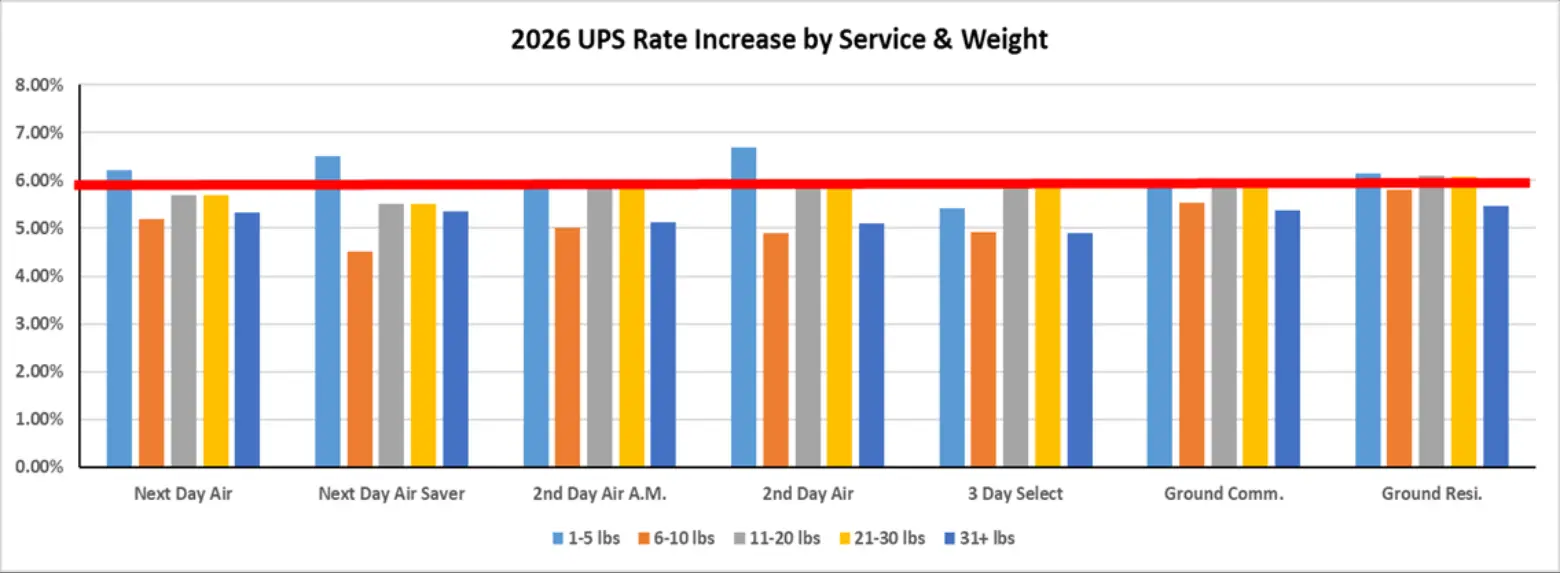
Chart 2:
Minimum Charges Keep Rising, Often Limiting Discounts for Many Shippers
This often-overlooked change can significantly limit negotiated discounts. If your discounted rate hits the new minimum threshold, your effective discount disappears. Many companies unknowingly lose savings this way when new minimums reset pricing floors.
Table 2:
| Minimum Net Charge | 2025 Rate | 2026 Rate | Percentage Increase |
|---|---|---|---|
| 3 Day | $16.03 | $16.90 | 5.43% |
| 2 Day | $25.43 | $27.13 | 6.69% |
| Next Day Air Saver | $38.78 | $41.31 | 6.52% |
| Next Day Air | $42.42 | $45.06 | 6.22% |
| Ground | $11.32 | $11.99 | 5.92% |
| SurePost >1lb | $12.28 | $12.28 | 0.00% |
| SurePost <1lb | $12.18 | $12.18 | 0.00% |
New Dimensional and Weight Rules Will Push More Shipments into Higher-Fee Categories
UPS and FedEx are both adding new dimensional and weight criteria for Additional Handling and Large Package surcharges starting in early 2026:
- Additional Handling: Applies to packages over 10,368 cubic inches
- Large Package: Applies to packages over 17,280 cubic inches or weighing more than 110 lbs.
They’ll also now round up any fractional inch in measurements, effectively increasing dimensional weight. Together, these changes mean more packages will trigger surcharges, even if the official rate increases look modest.
Delivery and Residential Surcharges Climb Faster Than the Headline GRI
Two of the most common surcharges, Delivery Area (DAS) and Residential, are again rising faster than the base 5.9% GRI.
These adjustments may look small in isolation, but for businesses with heavy residential or last-mile volume, they add up quickly. Combined with new dimensional rules, they can drive total shipment costs meaningfully higher than last year.
Graph suggestion: Instead of a dense table, use a map or shaded chart showing where surcharges are rising fastest, contrasting urban and rural regions.
Table 3:
| Surcharge | Zones | 2025 Rate | 2026 Rate | Percentage Increase |
|---|---|---|---|---|
| Delivery Area Surcharge | ||||
| Delivery Area Surcharge, Commercial Air | $4.20 | $4.50 | 7.14% | |
| Delivery Area Surcharge, Commercial Air Extended | $5.35 | $5.70 | 6.54% | |
| Delivery Area Surcharge, Commercial Ground | $4.20 | $4.50 | 7.14% | |
| Delivery Area Surcharge, Commercial Ground Extended | $5.35 | $5.70 | 6.54% | |
| Delivery Area Surcharge, Residential Ground | $6.15 | $6.55 | 6.50% | |
| Delivery Area Surcharge, Residential Ground Extended | $8.30 | $8.85 | 6.63% | |
| Delivery Area Surcharge, Residential Air | $6.15 | $6.55 | 6.50% | |
| Delivery Area Surcharge, Residential Air Extended | $8.30 | $8.85 | 6.63% | |
Table 4:
| Surcharge | Zones | 2025 Rate | 2026 Rate | Percentage Increase |
|---|---|---|---|---|
| Residential Surcharge | ||||
| Residential Surcharge, Ground | $6.10 | $6.50 | 6.56% | |
| Residential Surcharge, Air | $6.55 | $7.00 | 6.87% | |
Shippers Can Limit the Impact by Analyzing Data, Exploring Options, and Renegotiating Early
Now is the time for shippers to prepare.
- Request a rate impact analysis from your UPS representative, detailing how the 2026 GRI affects your actual shipment mix.
- Audit your shipping profile to understand which services and weights dominate your spend.
- Evaluate regional carriers such as OnTrac, GLS, and Amazon Shipping as leverage points in negotiations.
- Renegotiate early. The GRI provides a valid reason to reopen pricing discussions and capture new concessions before rates take effect.
- Engage a partner like Shipware to model your data, quantify your true exposure, and negotiate optimized contracts that offset these increases.
Behind the 5.9% GRI, Real Shipping Costs Are Rising Faster Than Ever
While the 5.9% average rate increase appears steady compared to past years, the true cost impact for many businesses will be far greater. With new dimensional rules, higher minimums, and surcharges above average, shippers face cumulative increases well beyond the headline number.
The best response is proactive: know your shipping data, model the changes, and negotiate based on your specific exposure. In an environment where both major carriers move in tandem, informed planning is the most effective way to control spend and protect margins.