

Your monthly carrier invoice contains a wealth of data, but most businesses only scratch the surface of what it can tell them. The key to unlocking real savings lies in analyzing your zone distribution. Knowing what percentage of your packages go to each zone is critical, as this profile directly shapes your total shipping spend. The system that organizes this data is built on UPS shipping zones. By learning to analyze your shipping patterns through the lens of these zones, you can identify your most expensive shipping lanes and uncover powerful opportunities for cost reduction, from contract negotiation to network optimization.
In e-commerce, every company should strive to minimize transit times, catalyze deliveries, and keep shipping expenses low. And if fulfillment optimization is your goal, it’s crucial to understand how shipping zones are defined—and how they’ll influence your overall fulfillment strategy. Businesses that ship high volumes to distant zones may benefit from zone skipping as a cost-saving strategy.
Shipping zones can affect nearly every facet of your shipping strategy, whether your capacity, average delivery times, or overall shipping costs.
In this guide, we’ll break down the nine domestic shipping zones and discuss how to optimize your fulfillment model, no matter where your shipments need to be delivered.
What Are Shipping Zones?
Shipping zones are geographical regions predominantly measured by the distance from a shipment’s point of origin to its ultimate terminus. They operate on two principles:
- The closer a customer is to you, the lower the zone, and the faster their package will arrive.
- The further a customer is from you, the higher the zone, and the longer a package will take to reach its final destination
In the US, domestic shipment zones span from Zone 1 to Zone 8—1, the closest and 8, the hardest to reach.
While most shipping carriers use a zoning method, every carrier’s shipping method is different. For example, the UPS shipping zone method can slightly vary from FedEx or USPS shipping zones.
But, Generally speaking, a Zone Map will appear as follows:
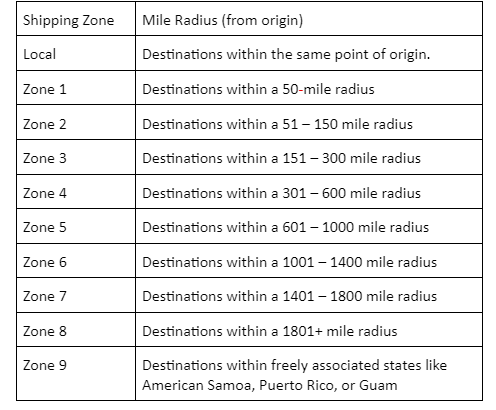
While distance is the primary gauge for designating zones, this distance is not measured in mileage but rather by zip code groupings.
For instance, it may be quicker to send a package from San Diego, CA, to New York, NY than from South Dakota to a rural location in West Virginia. While West Virginia is technically closer to South Dakota than New York to San Diego, sending a package to a location off the beaten distribution path can be more logistically complex for carriers.
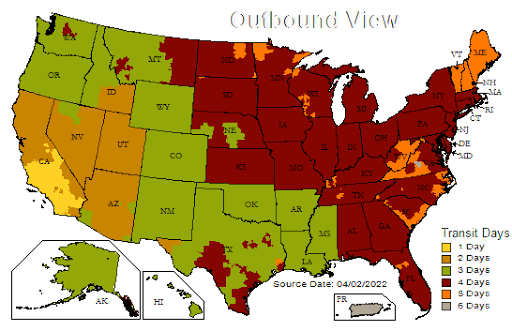
These intricacies may be easier to visualize by entering your business’ address in the UPS U.S. Ground Map.1 For example, the image below approximates how shipping zones would appear to a business located in San Diego, CA:
The UPS Zone Structure Explained
If you want to get a real handle on your shipping spend, the first thing to understand is how carriers like UPS build their pricing. The entire system is built on shipping zones, which are essentially how UPS measures the distance a package travels from your warehouse to your customer’s doorstep. Think of it as a dynamic map where the zones are calculated based on the origin and destination zip codes. In the simplest terms, a lower zone number means a shorter distance, which usually translates to a lower price and a quicker delivery. A higher zone number means the package is traveling farther, leading to a higher cost and a longer transit time.
Mastering this zone system is the first and most critical step toward building a smarter, more cost-effective shipping strategy. For any business shipping in volume, the distribution of packages across these zones directly impacts the bottom line. A small shift in your average shipping zone can mean thousands of dollars in savings or additional costs over a year. By analyzing where your shipments are going, you can start to identify opportunities for optimization, whether that’s through warehouse placement, carrier diversification, or negotiating better terms for the zones you ship to most frequently. It all starts with a solid grasp of the zone structure.
UPS Ground Zones by Mileage
For domestic ground shipments within the contiguous U.S., UPS uses a scale from Zone 2 to Zone 8. Each number corresponds to a specific mileage range from your point of origin. For instance, Zone 2 typically covers a radius of about 51-150 miles, making it one of the most affordable and fastest zones for delivery. At the other end of the scale, Zone 8 covers any destination over 1,800 miles away. As you can guess, shipping to these higher zones comes with a much steeper price tag. For companies that ship products nationwide, these zone-based price jumps can have a massive effect on profitability, which is why learning how to reduce high-volume shipping costs often begins with a deep dive into your zone data.
Understanding Domestic vs. Non-Mainland Zones
While mileage is a great rule of thumb, it’s crucial to know that zones are technically determined by groupings of zip codes, not just the straight-line distance. This can lead to some interesting results. For example, a package might get from a major hub like Los Angeles to New York City (a Zone 8 trip) faster than a package traveling a shorter distance between two remote, rural towns. That’s because major carrier routes between big cities are incredibly efficient. On top of that, shipments to non-mainland locations like Alaska, Hawaii, and Puerto Rico have their own unique zone categories and pricing structures. These details highlight the complexities hidden within carrier agreements, where expert contract optimization can reveal significant savings.
How to Determine Your Shipping Zone
If there’s one thing to remember about shipping zones, they aren’t set in stone. Shipping zones are dynamic and tied to your company location, which may differ significantly from business to business. Moreover, each carrier’s approach to zoning also varies.
Fortunately, it’s relatively simple to find out what your shipping zones are. First, visit the website of the carrier you want to use. From there, you can use their automated tools to calculate the shipping zone that corresponds with your shipment’s destination and estimated shipping costs.
For the three major shipping carriers in the US, just follow the following links:
- USPS Domestic Zone Chart
- UPS Ground Shipping Zone Maps
- FedEx Ground Shipping Zone Maps
How Do Shipping Zones Impact Your Business?
Every e-commerce business should know how shipping zones affect its business model and bottom line.
There are three main reasons you may feel the brunt of shipping zones: shipping costs, shipping weight, and your average time of fulfillment.
Shipping Costs
Most carriers will use zones to help determine the rates they’ll charge for shipping services. Generally, the further a package travels from its origin, the more it will cost.
Additionally, certain types of shipping services may be subject to zoning, whereas others aren’t. For example, while USPS Priority Mail Express is zoned, First-Class Mail isn’t. So, USPS zones will be used to determine a shipping rate for Priority Mail Express only.
For businesses that send shipments all over the country, understanding your per-package freight costs is essential for setting shipping prices for customers. If you select a standard charge for two-day shipping that’s too low, you could feel the pinch—especially if a significant portion of your customer base lives far away.
Dimensional (DIM) Weight
It’s not just about how heavy your package is, but also how much space it takes up. Carriers charge based on dimensional (DIM) weight, which is a calculation of a package’s length, width, and height. If you’re shipping a large, lightweight item like a box of pillows, the carrier will calculate both its actual weight and its DIM weight, then charge you for whichever is greater. This is because space on a delivery truck is a valuable commodity. When your packages ship to higher, more distant zones, the impact of DIM weight on your final cost becomes even more significant, making efficient packaging a critical part of your strategy to reduce distribution and fulfillment costs.
Carrier Surcharges
On top of the base rate determined by weight and zone, carriers add a variety of surcharges, or extra fees, that can substantially increase your total shipping cost. These fees cover everything from delivering to a residential address, fuel price fluctuations, handling oversized packages, or shipping during the busy holiday season. For many businesses, these accessorial charges can be a surprisingly large part of their monthly carrier invoice. It’s essential to understand which surcharges apply to your shipments, as they can compound the costs of shipping to higher zones. Performing a regular invoice audit is a smart way to ensure you’re not being overcharged or billed for services you didn’t receive.
Annual Rate Increases
Just like clockwork, major carriers like UPS and FedEx announce a General Rate Increase (GRI) each year. This increase doesn’t just affect the base shipping rates; it also applies to the long list of surcharges and fees. For companies that ship in high volumes, this annual price hike can have a major impact on the budget, eroding profit margins if not properly managed. While you can’t stop the GRI, you can mitigate its effects. The most powerful tool at your disposal is proactive carrier contract optimization, which involves negotiating for better terms, discounts, and incentives that can help offset the rising costs and protect your bottom line.
Shipment Weight
If you’re in the business of shipping heavier or bulkier items, sending shipments to higher shipping zones can have an even greater impact on pricing.
That said, there are ways to optimize your fulfillment strategy, reduce your zones, and lower your shipping costs. Instead of warehousing goods in a single location—particularly your heavier products—you can split them up into several locations across the country. That way, no matter where a customer lives, you can slash shipping expenses by sending the product from the shipping hub the fewest zones away from their location.
Fulfillment Times
As our handy UPS ground map demonstrates, higher zones simply take longer to reach.
If you promise all of your domestic customers a 2-day delivery on their orders, you’ll need to tailor your fulfillment strategy so that all of your merchandise is within range of your customers—in this case, 5 zones or less. If that’s not plausible for you as a business, you’ll need to amend your guarantee, so your shipping policies align with customer expectations.
How Transit Times Vary by Zone
Understanding how transit times change by shipping zone is key to setting up a fulfillment strategy that works. The basic rule is simple: the farther a package has to travel from your warehouse, the higher the zone number and the longer it will take to arrive. A shipment going to Zone 2 might take one day, while a package heading to Zone 8 from the same origin point could take a week or more via standard ground service. This is because the package has to move through more of the carrier’s sorting facilities and transportation hubs to reach its final destination. This dynamic directly affects the delivery promises you can make to your customers. For instance, if you offer a standard two-day shipping option but only ship from a single warehouse, you can likely only meet that promise for customers in lower zones. Aligning your shipping policies with these transit time realities is essential for customer satisfaction and a core part of any strategy to reduce distribution and fulfillment costs effectively.
Strategies to Reduce Zone-Based Shipping Costs
While you can’t change a shipping zone map, you can absolutely change your strategy to minimize its impact on your budget. High-zone shipping doesn’t have to mean high costs. By taking a proactive approach, you can find significant savings and create a more efficient fulfillment network. These strategies focus on making smarter decisions based on data, optimizing your physical operations, and holding your carriers accountable. Let’s explore some of the most effective ways to lower your zone-based expenses.
Analyze Your Shipping Data
You can’t fix what you can’t see. The first step to controlling zone-based costs is to get a crystal-clear picture of your shipping patterns. Trying to save money without this information is just guesswork. You need to know what percentage of your shipments go to each zone, the average cost per package for those zones, and which service levels you use most often for distant deliveries. A thorough analysis will reveal your most expensive shipping lanes and highlight your biggest opportunities for savings. This data-driven approach transforms your cost-reduction efforts from a shot in the dark to a targeted, strategic plan. With the right reporting and KPIs, you can turn raw numbers into actionable intelligence.
Optimize Your Packaging
Every inch and every ounce counts, especially when shipping to higher zones. Carriers use dimensional (DIM) weight to charge for packages, meaning you pay for the space your box occupies, not just its actual weight. Using oversized boxes for small items is a common way businesses unintentionally drive up costs. To combat this, implement a packaging optimization strategy. Use the smallest box that can safely hold your product and choose lightweight, void-fill materials. This simple change can lead to significant savings on DIM weight charges, which are amplified over the long distances of high-zone shipments. This is a foundational step to reduce your overall distribution and fulfillment costs and protect your margins on every order.
Negotiate Your Carrier Contract
Your carrier agreement is not set in stone; it’s a starting point for negotiation. Armed with the shipping data you’ve analyzed, you have powerful leverage to secure better terms. Go to your carrier with a clear understanding of your volume, your zone distribution, and your service usage. You can request targeted discounts on the specific zones or service levels that make up the bulk of your spend. For example, if 20% of your shipments go to Zone 8, a specific discount for that zone will be far more valuable than a general, lower discount. Experts in parcel contract optimization can use industry benchmarks to ensure you’re getting the best possible rates and incentives based on your unique shipping profile.
Audit Invoices for Accuracy
Even the most sophisticated carriers make billing errors, and those mistakes can add up to thousands of dollars in overcharges. Regularly auditing your shipping invoices is essential for catching these discrepancies and recovering the money you’re owed. Look for incorrect surcharges, charges for shipments that were delivered late (qualifying for a money-back guarantee), or incorrect residential fees. Manually checking every line item on thousands of invoices is a monumental task, which is why many businesses turn to an automated invoice audit and recovery service. This ensures you’re only paying for the services you actually receive and holds your carriers accountable for their performance promises, putting money directly back into your budget.
Implement Zone Skipping
Zone skipping is a powerful strategy for high-volume shippers who frequently send packages to distant regions. Instead of shipping individual packages from your warehouse across the country (e.g., from Zone 2 to Zone 8), you consolidate all packages going to that region. You then ship them together via LTL or truckload to a carrier’s sorting facility within the destination region. From there, the carrier handles the final-mile delivery. This process effectively turns a costly Zone 8 shipment into an inexpensive Zone 2 or 3 shipment, “skipping” the most expensive zones entirely. This is a key tactic in modal optimization that can dramatically lower your per-package cost for long-distance deliveries.
Use a 3PL or Multi-Warehouse Strategy
The most direct way to reduce zone-based costs is to reduce the distance your packages travel. If your business operates from a single warehouse, you’re automatically paying high-zone rates for a large portion of your customers. By implementing a multi-warehouse strategy or partnering with a third-party logistics (3PL) provider with a network of fulfillment centers, you can position your inventory closer to your customer base. Shipping from a facility in California to a customer in Los Angeles is a Zone 1 or 2 shipment, not a Zone 8 shipment from a warehouse in New York. This not only slashes shipping costs but also significantly shortens delivery times, improving the customer experience. Optimizing your 3PL contracts and network is key to maximizing these benefits.
Match Service Levels to Customer Needs
Faster isn’t always better, especially when it comes at a premium. Many businesses default to expensive air services for cross-country shipments to meet a two-day delivery promise, but this isn’t always necessary. Analyze your transit data to see if a more economical ground service could still meet customer expectations. You might find that ground shipping can reach many destinations just as quickly as pricier express options. Offering customers multiple shipping choices at checkout—such as a free ground option and a paid express option—empowers them to make the choice that best fits their needs and budget. This approach, combined with carrier diversification, allows you to select the most cost-effective service for every single shipment.
Offer Smart Shipping Promotions
Free shipping is a powerful marketing tool, but a one-size-fits-all approach can destroy your profit margins, especially on orders going to high zones. Instead of offering it to everyone, use your zone data to create smarter, more sustainable promotions. For example, you could offer free or flat-rate shipping to customers in Zones 1-4, where your costs are manageable. For customers in higher zones, you might offer a subsidized shipping rate or require a higher order minimum to qualify for a discount. This targeted approach allows you to use shipping as a promotional tool without sacrificing profitability on long-distance orders. Understanding your cost-to-serve for each zone is critical to designing promotions that drive sales and protect your bottom line.
Know Your Zones, Optimize Your Fulfillment
These days, the success and reputation of an e-commerce business depend on the integrity of its fulfillment strategy. Customers want their products as speedily as possible, and everybody wins when shipping costs—and logistics—are streamlined to a T.
While you can’t alter the country’s physical landscape, you can familiarize yourself with how shipping zones work. And with some industry know-how—and a competent shipping service—you can design a fulfillment strategy that meets your customer where they are without feeling the pinch in the process.
At Shipware, we can also help you reduce shipping costs and streamline your order fulfillment for better operations. Using audit and consulting services, we help ensure your parcel and LTL shipping is a smooth process. Contact us today to learn more!
Sources:
- UPS. U.S. Ground Maps. https://www.ups.com/maps/results?loc=en_US
Frequently Asked Questions
My shipping costs are high. What’s the first thing I should do to address zone-based expenses? Before you do anything else, you need to understand your shipping data. Your carrier invoices contain a complete story of where your packages are going. The first step is to analyze this information to see what percentage of your shipments go to each zone. This profile is your starting point for every other cost-saving strategy. Without knowing your specific zone distribution, you’re just guessing. Once you know that, say, 30% of your packages are going to expensive Zone 7 and 8 destinations, you have the leverage and focus needed to negotiate better rates or explore other fulfillment options.
How much can optimizing my packaging really save me on high-zone shipments? It can save you a significant amount. Carriers charge based on dimensional (DIM) weight, which means the space your package takes up on a truck is just as important as its actual weight. This effect is magnified for packages traveling to higher zones because that space is occupied for a longer, more expensive journey. Switching from a large, half-empty box to a smaller, rightsized one can lower your billable weight, sometimes dramatically. Think of it this way: every unnecessary inch you ship across the country costs you money, and those costs add up quickly over thousands of shipments.
When does it make sense to switch from a single warehouse to a multi-warehouse strategy? You should start considering a multi-warehouse strategy when you see two key signs. First, look at your shipping data. If a large and growing percentage of your orders are shipping to high zones (like Zones 6, 7, and 8), it’s a strong indicator that your single location is costing you a fortune. Second, listen to your customers or watch your competitors. If you’re losing sales because your standard delivery times to certain regions are too long, placing inventory closer to those customers can be a powerful competitive advantage that also happens to slash your shipping costs.
Is zone skipping a good strategy for every business? Zone skipping is a powerful tool, but it isn’t for everyone. It works best for companies that ship a high volume of packages and have a consistent concentration of orders going to a specific, distant region. The strategy requires enough volume to consolidate packages into a larger LTL or truckload shipment to make it cost-effective. If your long-distance shipments are spread out across many different areas without a clear pattern, the logistics can become too complex to be worthwhile. It’s a fantastic solution for the right shipping profile, but it’s not a universal fix.
Besides discounts, what else can I negotiate in my carrier contract to help with zone costs? Base rate discounts are important, but surcharges can be just as costly, especially on long-distance shipments. You can negotiate caps or waivers on specific accessorial fees that impact your business most. For example, you could negotiate a lower fuel surcharge, a reduced fee for residential deliveries, or a waiver for delivery area surcharges. These fees are applied on top of your zoned rate, so reducing them provides another layer of savings. A well-negotiated contract looks beyond the base discount to address the total cost of a shipment.
Key Takeaways
- Analyze Your Shipping Profile: Your shipping costs are directly tied to your zone distribution. Dig into your data to see where your packages are going, as this will pinpoint your most expensive shipping lanes and the best opportunities to save.
- Shorten the Trip to Lower the Cost: The most effective way to cut zone-based expenses is to reduce the physical distance your packages travel. Strategies like using multiple warehouses or trying zone skipping can transform expensive long-haul shipments into much cheaper local deliveries.
- Turn Data into Dollars: Your shipping data is a powerful tool for negotiation and cost recovery. Use your specific zone profile to secure better carrier contract rates and regularly audit your invoices to catch and correct expensive billing errors.