

Zone skipping is one of the highest-impact shipping strategies available to high-volume parcel shippers — yet most logistics teams either do not know it exists or assume it only works for the largest enterprises. In practice, any business shipping hundreds of packages per week into concentrated destination regions can use zone skipping to pay Zone 2 or Zone 3 rates on shipments that would otherwise travel at Zone 7 or Zone 8 prices. The savings per package are real, and at scale they compound into six- or seven-figure annual reductions in freight spend.
Want to find out how much zone skipping could save your operation? Request a free shipping analysis from Shipware — no obligation, no carrier changes required.
This guide explains what zone skipping is, exactly how the three-stage process works, who benefits most, what the real tradeoffs look like, and how to evaluate it against your own shipping data.
How Carrier Shipping Zones Drive Up Your Costs
To understand zone skipping, you first need to understand the zone pricing model that makes it valuable.
UPS, FedEx, and USPS price nearly every parcel shipment based on shipping zones — a distance-based tiering system that assigns a number (typically Zone 2 through Zone 8) to each shipment based on how far it travels from its origin ZIP code to its destination ZIP code. Zone 2 represents the shortest distances; Zone 8 is the farthest.
Zone assignment affects almost every cost element on a carrier invoice: base transportation rates, fuel surcharge calculations, residential delivery fees, delivery area surcharges, and accessorial charges all scale upward as zones increase. A 5-pound package shipped from a Southern California distribution center to a customer in New York might carry a Zone 8 base rate of $18.00 or more. The same package delivered to a customer 60 miles away might be Zone 2, costing $7.50.
For a business shipping 10,000 packages per week, the difference between optimized zone distribution and unoptimized zone distribution can represent millions of dollars annually. Most shippers accept this zone cost structure as fixed — but zone skipping proves it is not.
What Is Zone Skipping?
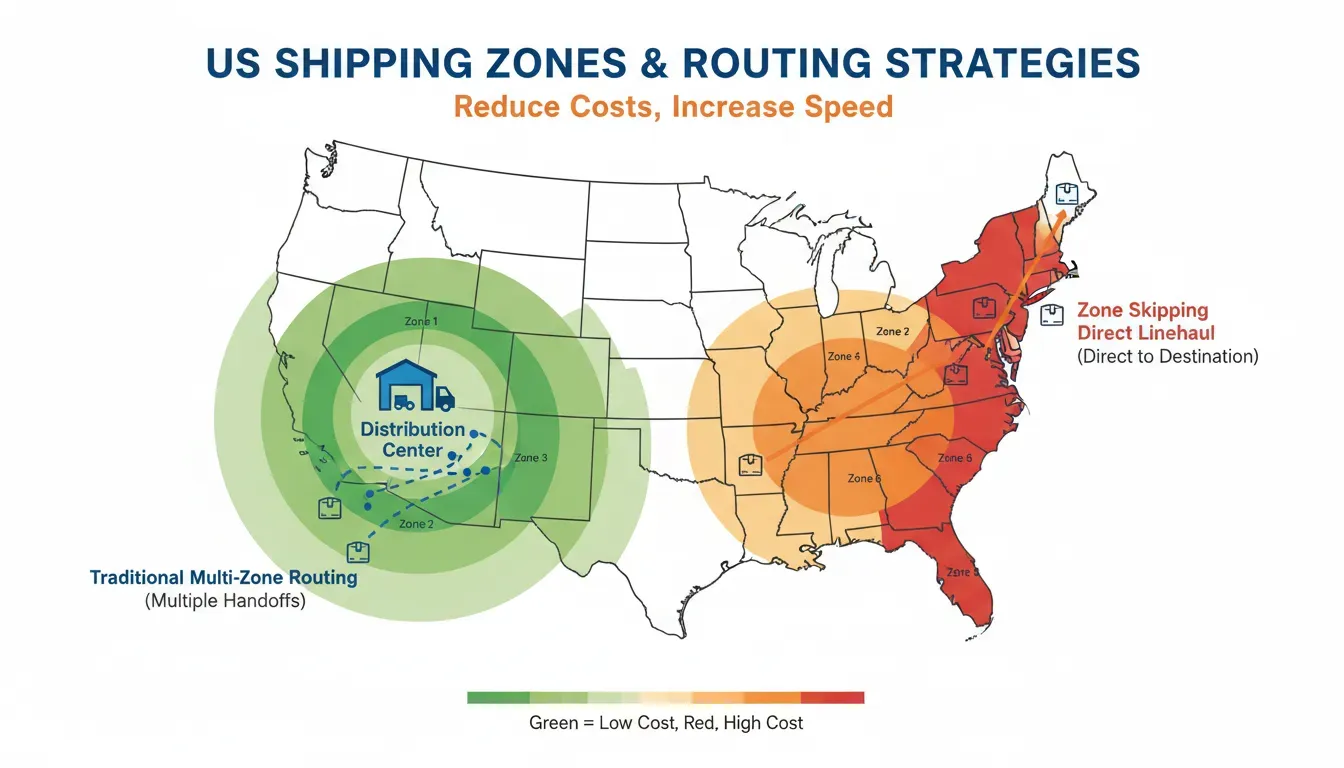
Zone skipping is a parcel shipping strategy that consolidates individual packages destined for a common geographic region into a palletized freight shipment, moves that freight via linehaul (full truckload or less-than-truckload) directly to a regional injection point near the final destinations, and then hands the packages off to the local carrier network for final-mile delivery at low-zone rates.
Instead of each package individually traversing five, six, or seven zones through the carrier’s national sortation network, the packages “skip” those intermediate zones by riding a dedicated freight move to the destination region. Once there, they enter the carrier network at a point close to the end customer, completing only Zone 2 or Zone 3 of final-mile distance.
The shipper pays freight rates for the long cross-country leg — which are dramatically cheaper per package at consolidation scale — and near-origin parcel rates for final-mile delivery. The carrier’s expensive national sortation grid is bypassed entirely.
How Zone Skipping Works: The Three-Stage Process
Stage 1: Consolidation at Origin
The process begins at the shipper’s distribution center or 3PL fulfillment origin. Rather than releasing individual packages into the carrier network as orders arrive, packages destined for a shared destination region are batched together over a set accumulation period — typically daily or every two to three days depending on volume.
A retailer shipping from a Chicago distribution center with consistent order volume into Texas, for example, would hold those packages rather than releasing them as individual Zone 6 or Zone 7 shipments. The accumulated packages are palletized, wrapped, and prepared for linehaul freight movement. Depending on volume, this may mean dedicating a full 53-foot trailer (FTL) or consolidating with other freight heading the same direction in a shared LTL load.
The key constraint at this stage is volume. Zone skipping requires enough packages going to the same region on a frequent enough basis to justify the consolidation infrastructure. Sporadic or thinly distributed regional volume reduces savings and increases complexity.
Stage 2: Linehaul Transport to a Regional Injection Point
The palletized shipment moves via a linehaul carrier directly to a regional injection point near the destination area. This injection point might be a carrier facility (such as a UPS or FedEx regional hub), a 3PL cross-dock, or a postal injection site authorized to induct packages into USPS or regional carrier final-mile networks.
This is where the zone skip actually occurs. Instead of each package entering the carrier’s national grid at origin and being sorted through multiple hub facilities en route, the consolidated freight arrives pre-sorted near its destination. The carrier’s expensive middle-mile sortation infrastructure is bypassed.
Linehaul freight rates are fundamentally different from parcel rates. Freight pricing is based on weight, freight class, and lane — not on individual package zones. A full pallet carrying 400 packages traveling from Chicago to Dallas on a linehaul lane may cost $350 to $500 in freight. Those same 400 packages shipped individually at Zone 6 rates might cost $4,000 to $6,000 in carrier charges. The per-package economics at consolidation scale are transformative.
Stage 3: Final-Mile Local Delivery
At the regional injection point, pallets are broken down. Individual packages are inducted into the local carrier network — whether UPS, FedEx, USPS, or a regional carrier like OnTrac, LSO, or Spee-Dee — for final-mile delivery.
From the local injection point, each package travels only Zone 2 or Zone 3 to reach its destination. The carrier prices this leg as if the package originated locally, because from the network’s perspective, it did. The shipper pays near-origin parcel rates for delivery.
The total cost is: linehaul freight + local parcel final-mile. For high-volume lanes, this beats traditional Zone 7 or Zone 8 parcel pricing by 15% to 30% per package, with faster delivery in many cases since the package arrives at the regional hub pre-consolidated rather than waiting for network sortation.
Shipware’s team of former UPS and FedEx executives has helped hundreds of businesses model zone skipping savings against their actual shipping data. See how carrier contract optimization works — zone skipping is one of the 250+ levers we evaluate for every client.
How Much Can Zone Skipping Save?
Savings depend on three variables: current zone distribution, package volume per lane, and the linehaul rate you can negotiate versus the parcel rate you are currently paying.
For a shipper with 60% or more of its package volume in Zones 5 through 8, zone skipping on those lanes typically delivers:
- 15% to 30% per-package cost reduction on bypassed lanes when linehaul consolidation economics work in your favor
- Faster transit times on many lanes, since pre-consolidated freight skips national hub sortation delays
- Reduced fuel surcharge exposure, because final-mile fuel surcharges apply to Zone 2 or Zone 3 rates rather than Zone 7 or Zone 8 rates
- Lower residential surcharge impact, since residential fees scale with the base parcel rate — which is lower at local zones
A high-volume e-commerce shipper moving 50,000 packages per month at an average zone of 6.2 could see $150,000 to $400,000 in annual savings by converting even 40% of that volume to zone-skipped lanes. Actual results vary significantly based on carrier rates, freight lane costs, and origin-destination density.
Who Benefits Most from Zone Skipping?
Zone skipping is not universally advantageous. It works best for shippers who meet specific volume and distribution thresholds:
High-Volume Shippers with Regional Concentration
The primary requirement is consistent volume into specific geographic regions. If a shipper in the Midwest sends 500+ packages per week into the Southeast, the linehaul economics can be compelling. If that same shipper sends 30 packages per week scattered across 40 states, zone skipping is not viable without volume aggregation through a 3PL.
E-Commerce and Direct-to-Consumer Brands
E-commerce companies with geographically clustered customer bases — particularly those shipping standardized products in predictable sizes and weights — are strong candidates. Uniform package profiles make linehaul weight and class calculations predictable and manageable.
Subscription Box and Recurring Shipment Operations
Businesses that release large batches of packages on a predictable schedule (monthly subscription boxes, seasonal campaigns, recurring replenishment) have built-in consolidation windows. This makes the batching stage operationally straightforward.
Shippers Using 3PL Partners
Third-party logistics providers with multi-client consolidation capabilities can pool volume across clients to reach zone skipping thresholds that no individual client could achieve alone. For shippers working with the right 3PL partner, zone skipping may be accessible at lower individual volume levels than expected.
Zone Skipping vs. Traditional Parcel Shipping: A Side-by-Side Comparison
| Factor | Traditional Parcel Shipping | Zone Skipping |
|---|---|---|
| Pricing basis | Individual package zone (Zone 2-8) | Linehaul freight + local Zone 2-3 final-mile |
| Middle-mile routing | Carrier national sortation network | Dedicated linehaul to regional injection point |
| Volume requirement | No minimum | High volume per regional lane required |
| Operational complexity | Low — hand off to carrier at origin | Higher — consolidation, linehaul, injection management |
| Transit time | Carrier-controlled, variable by zone | Often faster on targeted lanes |
| Cost savings potential | Baseline | 15%-30% on bypassed lanes |
| Fuel surcharge exposure | Applies to full zone rate | Applies to local (low-zone) rate only |
Potential Limitations and When Zone Skipping Does Not Work
Zone skipping is not a universal solution. Understanding its constraints helps determine whether it belongs in your shipping strategy or whether other cost-reduction levers — like carrier contract negotiation or modal optimization — will deliver better results for your specific profile.
Low or Dispersed Volume
If your shipments are spread thinly across the country with no regional density, there is no consolidation opportunity. Zone skipping requires predictable, recurring volume flowing to identifiable destination regions.
Perishable or Time-Critical Shipments
The consolidation and batching stage introduces a hold time before the linehaul departs. For time-critical shipments — perishables, medical supplies, same-day requirements — zone skipping introduces unacceptable delay risk. The strategy works for products where a one- or two-day accumulation window is operationally tolerable.
Low-Average-Zone Shippers
If your average zone is already 3 or below because your distribution centers are well-positioned relative to your customer base, zone skipping yields minimal savings. The strategy is most valuable when current zone averages are high (Zone 5+).
Carrier Service Guarantees
Some carrier service guarantee provisions may apply differently to zone-skipped packages depending on the injection method used. Review your carrier contracts carefully, or work with an expert who understands how guarantee terms interact with injection arrangements.
How to Evaluate Zone Skipping for Your Business
A rigorous zone skipping evaluation requires four inputs from your shipping data:
- Zone distribution report — what percentage of your packages fall in each zone, by carrier. Most carrier portals provide this, or it can be extracted from invoice data.
- Destination density map — which specific regions (ZIP code clusters, metro areas, or states) receive your highest package volumes.
- Current per-package cost by zone — extract from your carrier invoices, broken down by zone to understand where the savings pool actually sits.
- Linehaul rate quotes — get quotes from linehaul carriers or 3PLs for the lanes where consolidation economics look promising. Compare the per-package linehaul cost plus final-mile cost to your current full-zone parcel cost on the same lanes.
If the linehaul + final-mile total beats your current per-package cost on a lane by 15% or more with sufficient volume to absorb the operational overhead, zone skipping is likely worth implementing on that lane.
The analysis is straightforward in concept but complex to execute accurately — particularly when modeling fuel surcharge interactions, accessorial cost changes, and carrier contract commitment implications. Most shippers benefit from working with a logistics optimization partner who has done this analysis across dozens of similar operations and knows which assumptions to pressure-test.
Shipware’s analysts have the carrier pricing data and modeling tools to tell you exactly what zone skipping would save on your specific lanes — before you commit to any changes. Get a free analysis of your shipping spend.
Zone Skipping and Carrier Contract Strategy
Zone skipping does not exist in isolation. For shippers who also negotiate directly with UPS or FedEx, zone skipping changes the contract calculus in important ways.
First, volume commitments in carrier contracts are typically based on total parcel spend or package count with the carrier. If zone skipping reduces parcel injection volume on certain lanes, it may affect your tier qualification thresholds and earned discounts. A carrier contract expert should model this before implementation to ensure net savings are not partially offset by tier degradation.
Second, zone skipping may open opportunities to negotiate better rates on your remaining direct-injection volume by demonstrating carrier-switching leverage. When a carrier sees that you have the operational capability to redirect volume to a linehaul-injection model, contract negotiations often shift in the shipper’s favor.
Third, for shippers using USPS as the final-mile injection carrier (through a postal consolidator), the LTL-to-parcel modal shift introduces a different cost structure entirely — one that can deliver significant savings for lightweight residential packages but requires separate analysis of USPS rate tables and postage class optimization.
The interaction between zone skipping and your overall carrier contract strategy is one of the most technically complex areas in parcel optimization. It is also one of the highest-impact. Done well, zone skipping and contract optimization together can deliver 20% to 35% total freight spend reduction without changing carriers or service levels.
How Shipware Helps You Evaluate and Implement Zone Skipping
Shipware’s consulting team includes former UPS and FedEx pricing executives with decades of experience modeling carrier cost structures from the inside. When evaluating zone skipping for a client, Shipware applies the same analytical frameworks those executives used to structure carrier contracts — now applied on behalf of shippers.
The evaluation process includes:
- Full zone distribution analysis from your carrier invoice data
- Destination density mapping to identify the highest-potential consolidation lanes
- Per-lane savings modeling that accounts for linehaul rates, final-mile costs, fuel surcharge interactions, and accessorial charge changes
- Carrier contract impact assessment to model tier and commitment implications
- Implementation roadmap covering operational requirements, partner selection, and timeline
Shipware’s performance-based model means clients pay only when savings are realized. There is no upfront consulting fee and no risk of paying for analysis that does not produce results. The same approach Shipware applies to invoice audit and recovery — no savings, no fee — applies to its full optimization suite.
Frequently Asked Questions About Zone Skipping
What volume do I need to start zone skipping?
There is no universal threshold, but most shippers need at least 200 to 500 packages per week flowing to a single destination region to make consolidation economics work on a self-managed basis. Shippers working through 3PL consolidators can access zone skipping at lower individual volumes by pooling with other clients in shared linehaul loads.
Does zone skipping require changing my carrier?
No. Zone skipping uses your existing carrier relationships for final-mile delivery. The change is in how packages reach the regional injection point — via linehaul freight rather than the carrier’s national parcel network. Your carrier relationships, service levels, and customer-facing delivery experience remain intact.
Will my customers notice any difference in delivery speed?
On many lanes, zone skipping actually improves transit times because consolidated freight reaches regional hubs faster than individual packages moving through national sortation. In some cases, especially where the batching window adds 24 hours, transit times may be similar. The impact depends on your specific lanes, volumes, and accumulation frequency.
How does zone skipping affect carrier contract commitments?
This depends on your specific contract terms. Zone skipping may reduce direct-injection volume with a carrier, which can affect tier thresholds and earned discounts. A thorough contract review is essential before implementing zone skipping at scale. Shipware’s analysts routinely model this interaction for clients to ensure net savings are positive after contract effects are accounted for.
Can zone skipping work with USPS as the final-mile carrier?
Yes. Many zone skipping implementations use USPS as the final-mile carrier through postal consolidation programs. This is particularly effective for lightweight residential packages where USPS rates are competitive. The analysis differs from UPS/FedEx injection and requires evaluation of USPS postage class optimization alongside the linehaul economics.
Is zone skipping the same as freight consolidation?
They are related but distinct. Freight consolidation refers broadly to combining shipments to reduce cost. Zone skipping is a specific strategy that uses freight consolidation on the middle-mile leg specifically to inject packages into the carrier network at a lower zone — achieving parcel cost savings, not just freight consolidation savings.