

Let’s talk about the number that really matters to your shipping spend, and it isn’t 5.9%. While the official FedEx 2024 general rate increase 5.9% grabs the headlines, the true financial story for high-volume shippers is buried deep in the surcharge tables. Fees for large packages, for example, are set to climb by a staggering 18% to 21%. For many businesses, these accessorial fees can make up 40% or more of their total parcel costs. Understanding these specific hikes is the first step toward controlling them. We’ll dissect the most impactful surcharge changes and show you how to mitigate their effect on your budget.
This article first appeared in Multichannel Merchant on Sept. 11, 2023
Written by: Paul Yaussy Happy New Year! Effective January 1, 2024, FedEx Express package and freight standard list rates for U.S., U.S. export, and U.S. import services, and FedEx Ground standard list rates will increase an average of 5.9%. The September 7th General Rate Increase (GRI) release marks the earliest announcement in company history. While it’s impossible to analyze every 2024 change in pricing, below are some important takeaways for all shippers to note and assess:
Breaking Down the 2024 FedEx Rate Increase
When FedEx announced its General Rate Increase (GRI), the headline number was an average of 5.9%. But as any high-volume shipper knows, the word “average” can hide a lot of details. The actual impact on your shipping spend depends entirely on your unique shipping profile—the services you use, your package characteristics, and your destinations. This is why simply budgeting for a 5.9% increase isn’t enough. You have to look at the specific changes to surcharges, minimums, and fees that will affect your bottom line the most. Understanding these nuances is the first step toward building a strategy to mitigate the impact on your budget.
This increase isn’t happening in a vacuum. It reflects broader economic trends and specific operational pressures facing the logistics industry. For businesses, it underscores the importance of having a proactive shipping strategy. Relying on last year’s budget or assuming the announced average applies universally can lead to significant cost overruns. Instead, this is the perfect time to analyze your shipping data, review your carrier agreements, and explore ways to optimize your operations. A thorough audit of your shipping invoices can reveal exactly how these new rates are affecting your costs and where you have opportunities to save.
The Official Numbers: What FedEx Announced
FedEx made its 2024 rate announcement earlier than ever, signaling a clear direction for the year ahead. The company officially stated that standard list rates for its core services would see a significant hike. According to their newsroom, “Effective January 1, 2024, FedEx Express package and freight standard list rates for U.S., U.S. export, and U.S. import services, and FedEx Ground standard list rates will increase an average of 5.9%.” This figure serves as a baseline for shippers, but the real work lies in dissecting the updated service guides to understand the full picture, including changes to dozens of accessorial fees and surcharges that can inflate your final costs.
FedEx Express, Ground, and Home Delivery
The 5.9% average increase applies across FedEx’s most popular services: Express, Ground, and Home Delivery. However, it’s crucial to remember that this is not a flat-rate increase. Certain services, zones, and weight classes will see increases much higher than the announced average, while others might be lower. For example, surcharges for Additional Handling and Oversize packages often see some of the steepest hikes, disproportionately affecting businesses that ship large or irregularly shaped items. A detailed analysis is the only way to forecast the true financial impact and identify areas where carrier contract optimization could provide significant relief.
FedEx Freight
For shippers utilizing Less-Than-Truckload (LTL) services, the news is similar, though with a bit more variability. FedEx announced that its Freight rates for services within the U.S. and between the U.S. and Canada will go up by an average of 5.9% to 6.9%. The specific increase a shipper experiences will depend on their customer-specific agreement and shipping patterns. This range indicates that FedEx is applying more tailored increases within its LTL network, making it even more important for freight shippers to review their pricing agreements and understand how their specific lanes and classifications will be affected in the new year.
How the GRI Compares to Competitors
FedEx’s rate increase didn’t come as a surprise, especially when you look at the rest of the market. The major carriers tend to move in lockstep with their pricing strategies, creating a predictable yet challenging environment for shippers. Comparing FedEx’s GRI to those of its main competitors, UPS and USPS, provides valuable context and highlights potential opportunities for shippers to diversify their carrier mix. For businesses looking to control costs, understanding how each carrier is adjusting its rates is key to making informed decisions and maintaining a competitive edge in a market with rising logistics expenses.
UPS Rate Increases
In a move that surprised almost no one in the industry, UPS mirrored FedEx’s announcement precisely. As noted by Trax Technologies, “The official rate increase for both companies is 5.9%.” This parallel pricing strategy has become an annual tradition, reinforcing the duopoly’s market position. For shippers, this means that simply switching from one carrier to the other is unlikely to yield significant savings on its own. Instead, effective cost reduction requires a more sophisticated approach, focusing on optimizing agreements with both carriers or exploring a strategy of carrier diversification that includes regional carriers and other specialized services.
USPS Rate Increases
While the United States Postal Service also plans price hikes, its approach often differs from the private carriers. One of the most notable distinctions is its strategy around peak season surcharges. While FedEx and UPS have implemented hefty holiday surcharges for years, ASICentral reported that “USPS is not adding any extra holiday surcharges in 2023.” This can make USPS a more cost-effective option for certain packages, particularly for businesses that see a major surge in volume during the fourth quarter. This difference highlights the value of a multi-carrier strategy, allowing shippers to leverage the strengths of each provider to optimize for both cost and service level.
Industry Pressures Driving Costs
The annual rate increases from carriers like FedEx aren’t arbitrary; they are a direct response to a complex set of economic and operational pressures. From rising labor costs to massive investments in network infrastructure and technology, carriers are facing significant expenses to keep their operations running smoothly and efficiently. Understanding these underlying factors can help you appreciate the “why” behind the rate hikes. It also reinforces the reality that these upward pricing trends are likely to continue, making proactive cost management an essential business function rather than a one-time project.
Rising Operating and Labor Expenses
A primary driver behind the 2024 rate increases is the escalating cost of doing business. According to ASICentral, both FedEx and UPS “say they are raising prices to cover higher operating costs and to invest in better services and technology.” Furthermore, labor expenses have become a major factor. Following high-profile contract negotiations, particularly UPS’s new agreement with the Teamsters, the cost of labor in the logistics sector has risen substantially. As Trax Technologies points out, “A big reason for these increases is the rising cost of labor.” These expenses are inevitably passed on to shippers in the form of higher rates and surcharges.
#1 Rare decrease in GRI
For the past two plus decades, the annual rate increase generally remained the same, or grew. Typically, both FedEx and UPS announced the same rate increase each year around the same time. Prior to Covid-19, both carriers announced modest 3.9% to 4.9% increases. In 2022, we saw a record breaking 5.9% increase followed in 2023 by yet another record breaking 6.9%. In 2024, FedEx has announced a rare deceleration of the rate of increase, falling back to 5.9%.
#2 Earliest announcement ever
The FedEx GRI announcement follows a trend where both carriers declare rate increases earlier than the prior year. This not only allows shippers ample time to create 2024 budgets with knowledge, but also the ability to negotiate those increases down. Further, one of the things that makes this year’s announcement unique is that strategically FedEx put pressure on UPS to match as it comes out of a costly negotiation with its labor force. This shot across the bow seems to have worked as UPS responded with their own 5.9% rate increase a week later.
#3 Rate increases are similar across most weight breaks, but longer zone shippers will see higher increases
As illustrated by the following charts, all services will see rate increases across all weight breaks, and most all above the 5.9% target line. With the exception of 2Day AM, FedEx raised rates above 5.9% for all shipments to zones 5-8. Conversely, most services see a smaller increase for zones 2-4. FedEx may be telegraphing one of two things:
- Shippers with extended zones will continue to pay more year over year.
- It may be a direct acknowledgement of more competition from regional carriers for the shorter haul shipments.
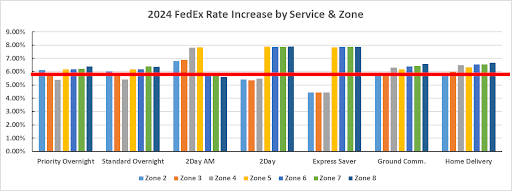 The trend continues from previous years where FedEx illustrates a clear preference for packages 10 pounds and under. Those packages see a smaller rate increase compared to shipments 11 pounds and over. Is the regional carrier impact at play here again? Yes, regional carriers tend to compete at the lower weight breaks.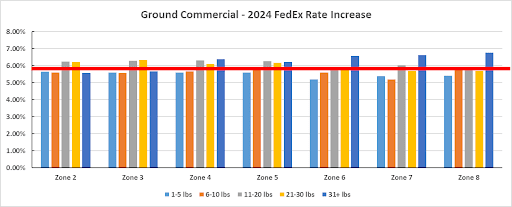
#4 Don’t forget the impact of minimum charge increases
For shippers with existing discounts, the minimum charge, or floor price, operate hand in hand with the rate increase. The floor price gives additional protection to FedEx from any discounts they have already conceded. For example, even if you have a 100% discount, you would pay $10.10 for a ground shipment in 2023, or $10.70 in 2024, without negotiating minimum concessions. Yearly minimum charge increases can have a dramatic impact on your shipping costs. In Chart Three, you can clearly see FedEx is more aggressive on Priority Overnight and Standard Overnight services, with increases ranging from one to two points higher than the general rate increase. Because FedEx is one of only two national carriers, these are the services that distinguish them from the competition and have rates that can accelerate at higher clips. Meanwhile, Ground and 2Day services fall in line with the general rate increase. 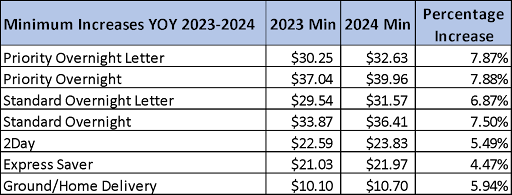
#5 Surcharges continue to rise higher than the announced general rate increase
Most read the headlines, or the email from their carrier rep, and think all their rates are increasing 5.9%. If you are not careful, you can blow your parcel budgets with this thinking because the annual GRI announcement does not limit surcharges to the 5.9% rate increase. Again, this year, most common surcharges will increase significantly more than 5.9% and, depending on your specific profile, may be extremely detrimental to your parcel pricing. Surcharges make up between 20% and 40% of a parcel shipper’s annual spend. So, it’s critical you understand the impact of these increases. Of note, shippers of large packages will once again be severely impacted by the 2024 increase. Additional Handling surcharges and Oversize surcharges are increasing between 18% and 21%. Table One below does not illustrate all surcharges but does highlight the most commonly charged additional fees. 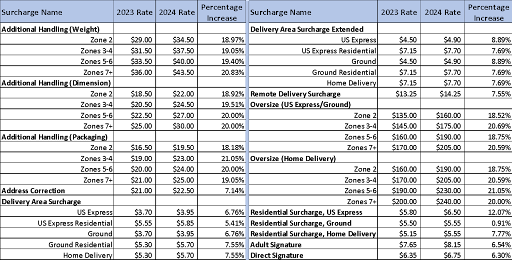
Why Your Total Costs Will Likely Exceed 5.9%
When carriers announce an average rate increase, it’s easy to plug that number into your budget and move on. But the 5.9% figure is just the headline. The reality is that your actual cost increase will likely be much higher, and the main culprits are surcharges. The annual GRI announcement doesn’t cap surcharge increases at that 5.9% average. In fact, many of the most common surcharges are set to jump by significantly more. This is where well-intentioned budgets get blown. Without a clear understanding of how these fees impact your specific shipping profile, you could be facing a much steeper bill than anticipated. The key is to look beyond the average and analyze how these individual fee hikes will affect your bottom line, which is a crucial step in any carrier contract optimization strategy.
Key Surcharge Changes to Watch
While dozens of surcharges are increasing, a few specific changes demand attention, especially for businesses that ship internationally or handle larger items. FedEx is once again placing a heavy burden on shippers of big and bulky packages, with some of the most dramatic increases seen in Additional Handling and Oversize surcharges. These fees can quickly add up, turning a profitable shipment into a costly one. For companies involved in global commerce, changes to international fees for multi-piece shipments and customs clearance will also have a significant financial impact. Staying ahead of these specific changes is essential for maintaining healthy margins and avoiding surprises on your invoices.
International Multi-Piece Shipment Fees
If your business frequently sends large packages, you’ll feel the sting of the 2024 increases most acutely. Additional Handling and Oversize surcharges are climbing by a staggering 18% to 21%. This isn’t a minor adjustment; it’s a substantial hike that will disproportionately affect shippers of furniture, equipment, and other bulky goods. These fees are often applied per piece in a multi-piece shipment, compounding the cost. It’s a clear signal from FedEx that they are continuing to penalize non-conveyable items that require manual handling and take up extra space. Businesses impacted by this should explore every option to reduce distribution and fulfillment costs, from packaging improvements to carrier diversification.
Customs Clearance Service Fees
For businesses that import goods, another fee to watch closely is the Customs Clearance Service Fee. Effective January 1, 2024, these fees are on the rise. While often overlooked in the grand scheme of shipping costs, these charges are a necessary part of bringing goods into the country. An increase here directly adds to your landed cost for imported products. This is another example of a cost that lives outside the base transportation rates but has a real impact on your total spend. Gaining full visibility into every line item on your carrier invoice, including these ancillary fees, is critical. Using a spend management portal can help you track these charges and understand their true impact on your shipping budget.
#6 Peak Surcharges to be called Demand Surcharges and will increase
A year after UPS made the name change, FedEx will now refer to Peak Season Surcharges as Demand Surcharges. These fees will increase and now can be charged throughout the year. As noted in the announcement, “We again anticipate the surge in residential volume to carry over into the new year.” Please refer to FedEx’s website for updates on the changing fees: https://www.fedex.com/en-us/shipping/rate-changes/demand-surcharges.html It should be noted that FedEx has not yet announced its GRI for Ground Economy.
Understanding GRI vs. Demand Surcharges
It’s easy to see the 5.9% General Rate Increase (GRI) and assume that’s the total impact on your budget, but this thinking can be a costly mistake. The GRI applies to your base transportation rates, but it’s just one piece of the puzzle. Surcharges, which can make up a significant portion of your total shipping spend, often increase at a much higher rate. The annual GRI announcement doesn’t cap these additional fees, meaning the true cost increase is often hidden in the fine print. Adding to the complexity, FedEx has followed UPS’s lead by rebranding “Peak Surcharges” as “Demand Surcharges.” This isn’t just a name change; it signals that these fees can be applied at any time of the year, making your shipping costs far less predictable.
A Look at Recent Holiday Demand Surcharges
The concept of a predictable “peak season” is quickly becoming a thing of the past. Carriers now anticipate that the surge in residential volume, once confined to the holidays, will extend well into the new year. This means that the surcharges you might have budgeted for only during November and December could now impact your bottom line in February or July. This constant potential for added fees requires a more dynamic approach to shipping management. Instead of reacting to seasonal spikes, businesses must now proactively monitor their shipping patterns and carrier announcements to avoid being caught off guard by unexpected costs that can erode their profit margins and negotiate better carrier agreements to protect their bottom line.
What can shippers do?
- Know your data and your specific shipping profile. That is the only way to fully analyze how these increases will impact you.
- Engage multiple carriers. Regional carriers are becoming increasingly viable for almost all shippers and often offer extremely competitive rates. It’s been a year since OnTrac and Lasership merged offering coverage to 80% of the population. GLS, and others, continue their expansion. Amazon announced earlier this year that Amazon Shipping is now a service provider and has offered services on a case-by-case basis where there is a mutual fit, with plans on continuous expansion in 2024 and beyond.
- Negotiate! With large increases and introductions of new charges, the carriers are opening the door for you to lobby them for relief.
In summary, while FedEx’s GRI decreased from 6.9% to 5.9% this year, shippers should still anticipate a double-digit price increase after factoring in all surcharge increases. The slowing of the annual increase can be viewed as a small win for shippers. However, there is never a wrong time to reach out to your carrier to discuss mitigation tactics. The key is to make sure you have a complete understanding of the impact of annual increases. Whether you have an in-house expert or partner with a consultancy, these increases can’t be ignored. Your budget is at stake, and you owe your organization the chance to have an informed negotiation with your carrier. Paul Yaussy is a Senior Professional Services Consultant for Shipware, where he consults and advises clients on transportation cost-reduction strategies. Paul joined Shipware in April 2021 after more than two decades in logistics management roles, most recently at JOANN Stores, where he distinguished himself as a transportation cost-reduction specialist and was responsible for leading the team that routed over $80M in parcel, truckload, intermodal, and LTL freight.
Frequently Asked Questions
My budget is set for a 5.9% increase. Is that enough? It’s a good start, but you should plan for a higher impact. That 5.9% figure is just an average applied to base rates. The real story is in the surcharges and fees, which can make up a huge portion of your total bill. Many of these fees, like those for large packages, are increasing by as much as 21%. Your actual cost increase will depend entirely on your specific shipping patterns, so relying on the average number alone can lead to some unwelcome budget surprises.
Why is there so much focus on surcharges? Aren’t they just small extra fees? Those “small” fees add up to become a major expense. For many high-volume shippers, surcharges can account for 20% to 40% of their total annual shipping costs. When these fees jump by double-digit percentages, they have a much larger financial impact than the general rate increase. Understanding which surcharges you pay most often is critical to getting a true picture of your shipping spend.
I have great discounts with FedEx. Won’t that protect me from these increases? Your discounts are valuable, but they don’t make you immune. Every shipment is subject to a minimum charge, which is essentially the lowest price you’ll pay for a shipment, no matter how deep your discount is. These minimums are also increasing this year. This means that even with a great discount, your floor price is rising, which can erode your savings, especially on lighter-weight shipments.
What does the change from “Peak” to “Demand” surcharges actually mean for my business? This is more than just a simple name change. Previously, “Peak” surcharges were mostly predictable and tied to the busy holiday season. By rebranding them as “Demand” surcharges, FedEx gives itself the flexibility to apply these extra fees at any time of year when their network is strained. This makes your costs less predictable and means you need to be prepared for these surcharges to appear outside of the traditional fourth-quarter rush.
This is a lot to take in. What is the single most important action I can take right now? The best thing you can do is get to know your own shipping data. A deep analysis of your shipping profile will show you exactly how these rate and surcharge increases will affect your specific business. Understanding which services you use, the characteristics of your packages, and the fees you incur most often is the only way to accurately forecast your costs. This knowledge is also your greatest asset when you negotiate with your carrier for relief.