

Shipping to a business in a commercial park is straightforward. But what about a business run out of a suburban home? Or a large apartment complex with a mailroom? For carriers, the lines can be blurry, and their classification directly impacts your bottom line. This is where the official ‘residential delivery meaning’ comes into play. It’s not just about whether someone lives at the address; it’s a specific designation carriers use that automatically triggers extra fees. We’ll break down how this system works, why it costs you more, and what you can do to manage these expenses.
Shipping is shipping, right? The items are wrapped up and a shipping label is prepared. The package goes from the shipper to the carrier to the recipient. So why does it cost different amounts, and why do carriers want to know if you are sending the parcel business vs residential shipping? As an ecommerce business or a retail store selling to both businesses and individuals, this difference adds complexity to the decision process of which carrier to use and how to better plan for shipping costs in the pricing, especially if free shipping is an option. Residential vs commercial shipping: it makes a difference which you use!
What does residential shipping mean?
In its most basic sense, residential shipping means the shipper is sending items to a home or private residence, aka a home delivery. But that is a simplistic way of looking at it because some businesses are based in homes. And that business might be receiving large quantities of boxes and supplies. A business can also be based in a residential area, and may be identified by shippers as a residential address, even if it’s a freestanding building only housing that business. It doesn’t matter if the residential delivery is parcel shipping, LTL freight shipping, or specialty services like White Glove delivery, a type of LTL shipping. If it’s a residential address, it will often cost you more. In residential vs commercial shipping, it matters if the business is based in a residential area because those surcharges add up, increasing the cost of doing business.
Residential vs. Final-Mile Delivery
You might hear the terms “residential delivery” and “final-mile delivery” used together, but they aren’t exactly the same thing. Think of “final-mile” as the broad category describing the last leg of a package’s journey from a distribution center to its ultimate destination. Residential delivery is just one specific type of final-mile service, where the destination happens to be a home. The final-mile umbrella also covers more involved services, sometimes called “white glove” delivery, which can include bringing items inside, assembling furniture, or hauling away old appliances. Understanding this distinction is key because the services required at the final destination heavily influence your overall shipping costs.
What is a Residential Delivery Indicator (RDI)?
Carriers don’t just guess if an address is a home or a business; they use a system called the Residential Delivery Indicator, or RDI. This is an automated tool that carriers like UPS and FedEx use to verify and classify every address in their system. When you create a shipment, the carrier’s system checks the address against its RDI database. If it’s flagged as residential, a residential surcharge is automatically applied to your invoice. This is why you can sometimes be charged a residential fee even when shipping to a home-based business. The RDI classification is the final word, and it directly impacts your shipping spend.
Common Items Shipped to Residences
While any parcel can be sent to a residence, certain items are more commonly associated with the complexities and higher costs of residential freight. This often includes large, bulky, or heavy goods that require more than a standard parcel delivery. Think about items like furniture, large appliances, exercise equipment such as treadmills, and mattresses. It also includes things like large DIY kits for sheds or playsets and even full pallet orders for home-based businesses. As e-commerce continues to grow, sellers of these larger products must factor residential and final-mile surcharges into their pricing strategy to protect their profit margins and manage their overall shipping spend.
What does business shipping mean?
Business, or commercial shipping, means the order goes to a business address. “Business” is a broad term, which can be a store, or it can be a manufacturing plant, a healthcare system, a house of worship, or a farm. Commercial shipments tend to be larger quantities of packages than residential addresses. They can also be LTL freight or FTL freight shipments. While some businesses are classified as residential deliveries because they are in residential areas, the reverse can be true as well. Some residences are in commercial locations. Or you can get a situation where a large apartment complex, especially one with mixed–use, is deemed commercial by the carrier. The shipping company can classify the location based on its own rules. The carrier might also rely on the government’s zone designation as business vs residential for shipping.
The Residential Delivery Process Step-by-Step
While dropping a small parcel on a front porch is a simple affair, the process for larger residential deliveries, particularly LTL freight, is more involved. It requires coordination between the carrier and your customer, adding extra steps that can impact both the delivery timeline and your overall costs. Understanding this process helps you set clear expectations for your customers and manage your logistics more effectively. From scheduling the final drop-off to the final signature, each step plays a role in a successful delivery and in protecting your business from unnecessary expenses.
Scheduling the Delivery Appointment
Once a shipment arrives at the local terminal nearest to your customer’s home, the process becomes more hands-on. The freight carrier will contact the recipient directly by phone to schedule a specific delivery appointment. This is a key difference from standard parcel delivery and is a required step for most residential freight. During this scheduled time, a local driver will bring the item to the residence. For heavy or bulky items, the truck is often equipped with a liftgate to safely lower the freight from the truck to the ground. It’s important to remember that services like delivery appointments and liftgate use are considered accessorials and typically come with surcharges that can impact your distribution and fulfillment costs.
Inspecting for Damage and Signing
The final step is perhaps the most critical for you as the shipper. When the delivery arrives, the driver will ask your customer to sign a Proof of Delivery (POD). Before they sign, it is essential that they thoroughly inspect the exterior of the packaging for any signs of damage—dents, tears, or crushed corners. If any damage is found, the customer must note it on the POD before signing. A clean signature without any notation implies the shipment was received in perfect condition, which can make it nearly impossible to file a successful damage claim with the carrier later. Educating your customers on this step is vital for protecting your revenue and ensuring you can recover costs when carrier mishandling occurs.
Is business shipping cheaper than residential?
Usually, business shipping is cheaper than residential shipping. Residential shipping tends to be delivered to a lower-density area. That means delivery drivers make more stops on average, and the locations are farther apart. The residential streets can also be more difficult to navigate if they are narrower with cars crowding the curbs. That makes it hard to maneuver. They may need to send smaller trucks without tailgates. Additionally, these smaller trucks can carry and deliver fewer packages simultaneously compared to a larger 18-wheeler that is delivering multiple pallets or a larger volume of parcels to one location. Residential roads may have town restrictions on weight, and drivers may need to watch for heavier pedestrian traffic and kids en route to or from school. These are some of the reasons that residential deliveries can be more expensive. Conversely, commercial addresses tend to be on more accessible streets, clustered closer together. That means one truck can deliver more packages — faster and with fewer resources. And this matters, since a big portion of the shipping cost is in the last mile portion.
Shipping zones
Note that it does not have to be more expensive to deliver to residential addresses. Carriers can decide which areas are designated for business vs residential shipping and when to add accessorial fees. Perhaps a residential address uses a dock and has a high volume of packages. Or they are on a wider street that can accommodate bigger trucks. The carrier may not put that address in the residential zone, thus lowering the cost of shipping. On the other hand, a commercial address may also fall near or in a residential area and may be charged residential rates. The carriers will often follow the city’s zoning designations, so if an address is in the residential area, it charges extra for that, versus those in the commercial area. That said, there still could be higher expenses if the delivery truck is too large to safely deliver to the address, resulting in additional costs like a redelivery fee or failed delivery attempt.
Common Residential Surcharges and Fees
The price you see upfront is rarely the final cost for residential shipping. Carriers add extra charges, called surcharges or accessorials, for any service beyond standard transit. These fees can inflate your shipping spend if you’re not watching them closely. Let’s look at some of the most common ones you’ll encounter so you can better anticipate your total shipping costs.
Liftgate Service Fees
When shipping heavy LTL items to a home without a loading dock, a truck with a liftgate is required to lower the freight to the ground. This specialized equipment isn’t standard on all trucks, so carriers charge a specific fee for this service. It’s a necessary cost for ensuring the safe delivery of large products to residential addresses that lack commercial-grade receiving infrastructure.
Appointment Delivery Fees
Carriers often need to schedule a specific delivery window for residential LTL shipments to ensure someone is available to receive them. This coordination disrupts their optimized routes, so they charge an appointment fee. This fee compensates the carrier for the time spent arranging the delivery and adhering to a fixed schedule, which adds a layer of complexity to their operations.
Limited Access Fees
Some residential areas are difficult for large trucks to enter due to narrow roads, weight restrictions, or tight turns. Carriers classify these as “limited access” locations and apply a surcharge. This fee covers the added cost of using a smaller, specialized vehicle to complete the delivery, which is a common issue in many suburban and rural neighborhoods across the country.
Inside Delivery and White Glove Service
Standard delivery is often just to the curb. If the driver needs to bring an item inside the home—even just into the garage—it’s an extra service called inside delivery. A more comprehensive “white glove” service might include placement in a specific room and debris removal. Both services add significant costs for the extra labor and time involved, so it’s important to clarify which level of service your customer expects.
Re-delivery and Storage Fees
If a delivery attempt fails because no one is home to sign, the carrier will charge a re-delivery fee for the next attempt. If the package is held at the carrier’s facility, you could also face daily storage fees. These preventable charges highlight the importance of accurate invoice auditing to ensure you’re not overpaying for service failures or incorrect surcharges.
Minimizing the costs for residential vs commercial shipping
With costs typically higher for residential vs commercial shipping, there are some ways to mitigate those costs. Knowledge is power! Inflation has hit shipping costs like it hit so many other sectors. FedEx raised its rates for residential delivery charges for various services between 2021 and 2022. 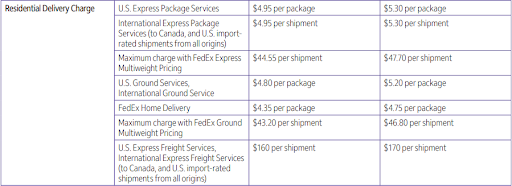 *Image source: Fedex UPS also charges a residential accessorial charge for businesses operating out of homes.
  To lower the cost of business vs residential shipping, there are a few options. The first is to find carriers that identify the areas of most importance to that shipper as a commercial delivery area. There could be multiple reasons they would do that, as mentioned earlier. You could use multiple carriers for your delivery needs, or move your business over to that carrier, if it makes the most sense holistically. Finding a shipping service that best suits your needs and address can be a great yet simple way to lower your shipping rate.
Optimize Warehouse and Inventory Placement
Another effective strategy is to look at where you’re storing your inventory. If you’re shipping everything from a single warehouse, you’re likely paying a premium to ship to customers on the other side of the country. To save money and speed up delivery, you can store your products in warehouses that are closer to your customers. This approach, known as distributed inventory, shortens the last-mile journey. By strategically placing inventory in multiple fulfillment centers based on customer locations, you can significantly reduce your distribution costs and transit times. This not only cuts down on expenses associated with higher shipping zones but also improves the customer experience with faster delivery, which is a major factor in customer satisfaction and repeat business.
Offer Alternative Delivery Locations
Since residential deliveries almost always come with surcharges, giving your customers other options can be a smart move. You could ship to a business address or a commercial pickup point instead of a home to avoid those extra fees. Many customers might prefer sending packages to their workplace, or they might appreciate the flexibility of picking up their order from a nearby carrier location or designated locker. By offering these alternatives at checkout, you can pass some of the savings on to the customer or simply improve your own profit margins. It’s a simple change that can have a big impact, especially if you explore special rate programs with carriers that support these alternative delivery models.
Improve Customer Communication to Manage Expectations
No one likes surprise fees. Customers who order online expect clear communication, especially when it comes to costs and delivery timelines. Be upfront about all shipping charges, including any residential surcharges, before the customer completes their purchase. Providing a clear breakdown of costs builds trust and prevents cart abandonment. It’s also crucial to give accurate delivery estimates and offer an easy way for customers to track their shipment. Even if shipping takes a little longer or costs a bit more, managing expectations from the start leads to happier customers and fewer support inquiries down the road. Transparency is key to a positive shipping experience.
Understanding shipping costs
It’s helpful to understand all the pricing options that impact your shipping needs, and this can be done on a case-by-case basis if you have relationships with multiple carriers. Shipping software is a great way to do this. The shipping software may present you with the option to make decisions per package. Or you can enter the parameters for choosing one carrier over another, whether it’s cost, delivery timing, or any special circumstances. The software can then manually generate the most appropriate shipping label or kick the package over to someone to make a decision if there’s an exception to the parameters. Ecommerce companies can make shipping costs transparent and charge customers for the shipping cost. This can be difficult if competitors offer free shipping, but if it means a company can stay in business, then it’s something to consider. Offering customers the choice of ground shipping versus a faster form of shipping can also lower costs, sometimes including a lower residential delivery fee. Lastly, send packages through the United States Postal Service. USPS is mandated to deliver to all homes in the country, and they do not charge extra for home delivery. It’s what they do. To get the best commercial rates with the USPS, consider its cubic shipping option, which lowers the price considerably. You may have to choose different packaging materials to get the best size and price.
Negotiating surcharge fee
It’s possible to negotiate the residential surcharge fee with carriers. It’s best not to do this as a one-off, but rather as part of an overall negotiating strategy. Small shippers with lower volume may not have as much leverage as larger shippers, but it’s still worth trying. Some smaller shippers get the same discounts using shipping software as they may get on their own. Shippers that have their own carrier contracts, though, should optimize the contracts by understanding the spending and sending patterns, and then using that data to negotiate discounts. Parsing the shipping patterns can be done by someone internally at your company. But, unless the person has a vast background in shipping, specifically on the carrier side, you would probably get more from the effort by using a specialist. Shipware’s experts come from the carrier side. They can dig through the shipping data to understand where a company spends the bulk of its money, where it is likely to get the most savings from negotiations, and how to use that data — including proprietary benchmark data — to gain those savings from the negotiations. Shipware then walks you through the strategy side, to help you realize the most savings for the areas most pertinent to your shipping needs. Contract optimization can save you up to 30% of your shipping costs.
Leverage Volume with a 3PL Partner
If you’re a smaller shipper, you might feel like you lack the leverage to negotiate better rates. This is where a Third-Party Logistics (3PL) provider can be a game-changer. These companies act as shipping experts, aggregating the volume from many businesses to secure more favorable terms with carriers than you could likely get on your own. They can help you understand your shipping options and build a smarter plan for your business. Whether you work with a 3PL or directly with carriers, the goal is the same: ensuring your contract is fully optimized. That’s why it’s critical to have experts who can analyze and improve your 3PL contract, making sure you’re not leaving money on the table.
The Future of Residential Shipping
With the continued growth of ecommerce, residential shipping isn’t just a line item anymore—it’s a core part of business strategy. The biggest hurdle has always been the “last-mile delivery,” which is the final, and most expensive, leg of a package’s journey to a customer’s doorstep. Carriers are constantly experimenting with ways to make this more efficient, from centralized pickup points and secure lockers to partnerships with local retailers. For your business, this means the landscape is always shifting. What was the cheapest option last year might not be the best choice today.
Staying competitive requires a deep understanding of your own shipping patterns. Having clear visibility into your shipping data allows you to adapt to these changes. When you can analyze your costs, delivery times, and accessorial fees in detail, you can make proactive decisions instead of just reacting to rising prices. Utilizing robust reporting and KPIs is no longer a luxury; it’s essential for managing the future of residential delivery and keeping your shipping costs under control. This data-driven approach helps you choose the right services and partners to meet customer expectations without sacrificing your profit margins.
Sustainable Shipping Initiatives
More and more, customers are paying attention to the environmental impact of their purchases, and shipping is a big part of that conversation. Luckily, sustainable shipping practices often align with cost-saving measures. For instance, consolidating orders or offering customers a small incentive for slower, ground-based shipping can reduce both your carbon footprint and your expenses. One of the most effective strategies is to optimize your packaging. Using the USPS cubic shipping option, for example, can significantly lower your costs by pricing packages based on their size rather than weight. This encourages you to use smaller boxes, which means less wasted material and more packages per truck, leading to greater fuel efficiency for the carrier.
The Role of Technology like AI and Drones
While futuristic ideas like delivery drones capture the imagination, the most impactful technology in shipping today is the software that powers your logistics. Modern shipping platforms give you the ability to make smart decisions for every single package that leaves your warehouse. Instead of being locked into one carrier, this software can automatically compare rates and delivery times across multiple providers, ensuring you get the best option based on your specific rules. This level of automation is critical for managing the complexities of residential surcharges. Furthermore, a sophisticated spend management portal uses data analytics to give you a complete picture of your shipping operations, identifying trends and opportunities for savings that would be impossible to spot manually.
Shipware can help control residential vs commercial shipping costs
Understanding how a shipping service works can be a big indicator of how much your shipping rate may be. Erroneous residential delivery surcharges can be caught through an invoice audit recovery program. This automated software program Shipware offers can analyze countless invoices to spot errors that a human would not be able to find. By flagging incorrect residential surcharges, and other mistakes a carrier makes, the program can help a shipper recover credit that would otherwise be lost. Shipware customers save up to 9% of their shipping costs with no cash outlay by using this software. There is no upfront cost to use the program, and all fees are covered by savings. The carrier applies credits directly to your account, making the process transparent and easy. There is a higher cost to shipping to residential addresses, but it does not have to be a budget-killer. Understanding how the accessorial charges work and ways to avoid some of them can play a big role in lowering shipping costs. To learn how to make some other simple changes to lower your shipping rates, please contact us.
Frequently Asked Questions
My business is run from my home. Will I always be charged a residential fee? Not necessarily, but it is very likely. Carriers use an automated system called a Residential Delivery Indicator (RDI) to classify addresses. This system relies on zoning data and its own database, not on whether a business is registered at the location. If your address is in an area the carrier’s system identifies as residential, the surcharge will probably be applied automatically, regardless of your business activity.
Why can’t I just select “commercial” when creating a shipment to avoid the residential surcharge? You can try, but it won’t work for long. Carriers audit shipments, and their systems will automatically verify the delivery address against their RDI database. When they find a mismatch, they will reclassify the shipment and bill you for the residential surcharge anyway. In some cases, they may even add a correction fee for the inaccurate information, so it’s best to be accurate from the start.
Are all these extra residential fees, like for liftgates and appointments, negotiable? Yes, many surcharges can be negotiated, but it’s not as simple as just asking for a discount. Successful negotiations are part of a larger contract optimization strategy. Your ability to get reductions on these fees depends heavily on your shipping volume and your overall spending with the carrier. Using data to show your shipping patterns and value as a customer is the key to a productive conversation.
What’s a practical way to reduce residential shipping costs without changing my carrier contract? A great strategy is to offer your customers alternative delivery options at checkout. Allowing them to ship to a business address, like their workplace, or to a designated commercial pickup point can completely eliminate the residential fee. Another effective method is to analyze where your customers are and place inventory in fulfillment centers closer to them. This shortens the final delivery distance and can significantly lower your overall costs.
How can I find out if I’m being overcharged for residential deliveries? The most reliable method is to conduct a thorough invoice audit. This means reviewing every line item on your carrier invoices to check for errors, especially incorrect residential surcharges applied to commercial addresses. While you can do this manually, it’s incredibly time-consuming. Using an automated invoice audit service is far more efficient and can uncover billing mistakes you might miss, ensuring you get credits back for any overcharges.
Key Takeaways
- Address classification dictates cost: Carriers use a system called the Residential Delivery Indicator (RDI) to classify every address. A residential flag automatically adds surcharges, as these deliveries are typically less efficient and more complex than shipping to a commercial hub.
- Look beyond the base shipping rate: The initial quote for residential shipping rarely includes all costs. Be prepared for accessorial fees for services like liftgates, delivery appointments, and inside delivery, which can significantly increase your final invoice.
- A strategic approach can lower expenses: You can actively reduce costs by negotiating carrier contracts with data-driven insights, offering customers alternative pickup locations, and using an invoice audit service to find and recover erroneous surcharges.